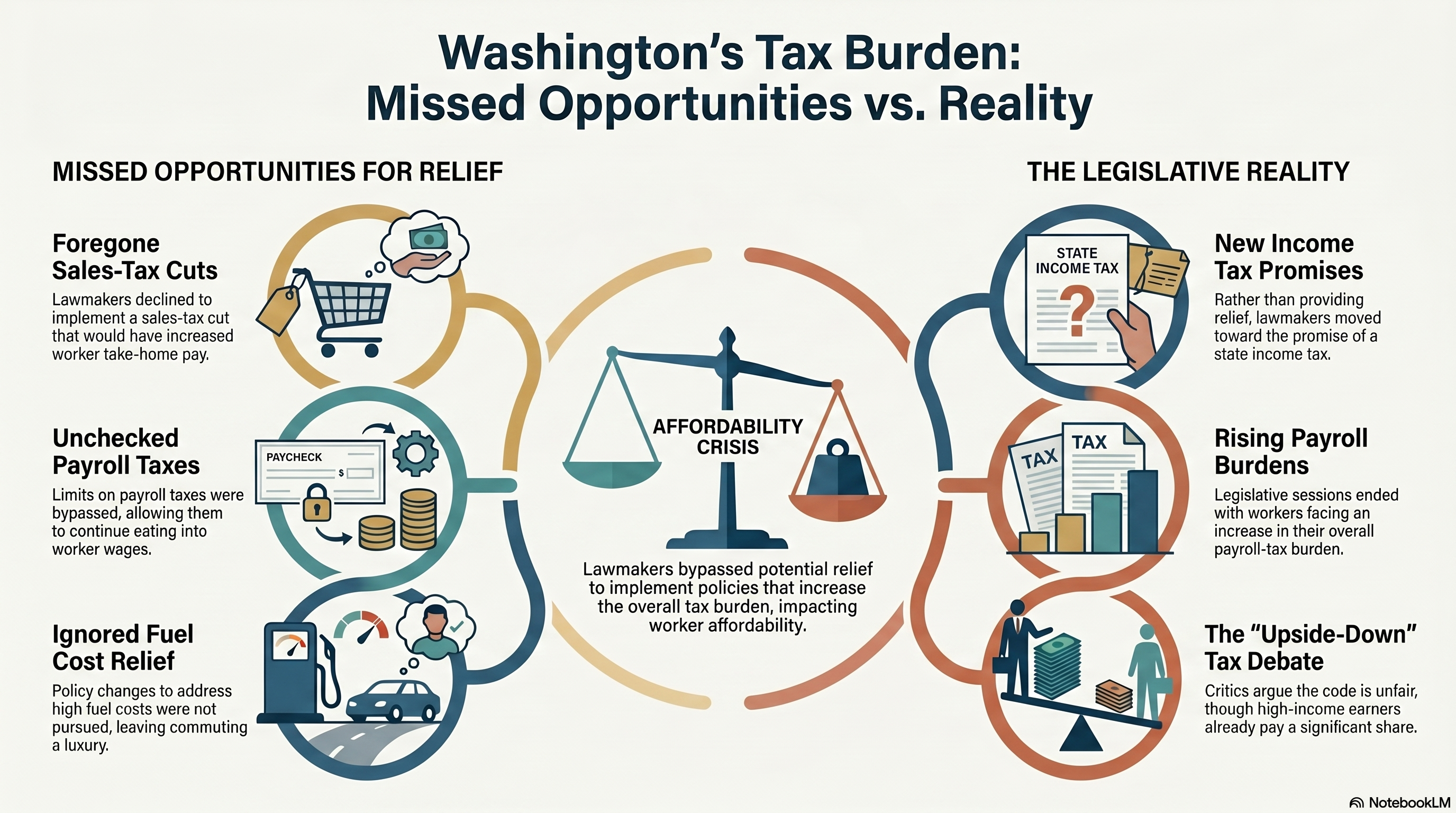



Washington state lawmakers could have given workers a sales-tax cut this past legislative session. They could have lowered or enforced limitations on the payroll taxes eating into workers’ wages. They could have changed state policies that make driving to work a luxury, given our state’s high fuel costs. But instead, they gave workers the promise of an income tax and a rising payroll-tax burden.
Any of those tax-relieving moves lawmakers did not take would have made a meaningful dent in the state’s affordability problem. They also would have made a more convincing case that lawmakers are serious about righting what many of them call an upside-down tax code. (I do not call it that. Those with higher incomes deserve thank-you cards from the rest of us for paying more than their fair share of the tax bill.)
Washington state, as we all know, is already one of the most expensive places in the country. A recent report from the Washington Roundtable and Kinetic West shows the state ranks fifth most expensive in the U.S., trailing only California, Washington, D.C., New Jersey and Hawaii. Rather than help Washingtonians by decreasing unsustainable spending and offering tax relief in the ways mentioned above, majority lawmakers here decided to chip away at one of the competitive advantages the state still has. Gov. Bob Ferguson signed a new 9.9% income tax into law in March.
This income tax still faces a court challenge because it violates the state constitution. A voter challenge will also likely surface in November before the first payments are due in 2029. (Read more about the tax-repeal initiative in search of signatures here. To qualify for the November ballot, 308,911 signatures are needed by July 2. To make up for invalid or duplicate signatures, the secretary of state’s office advises gathering closer to 400,000.)
Regardless of these challenges, the state will begin hiring people to implement the tax beginning July 1, the new fiscal year. It anticipates hiring 300 new employees by 2030 to do the work required under the tax changes approved this year.
You get a tax, you get a tax, you get a tax!
High- and low-income workers here have already seen their wages reduced directly because of misguided state policy. Two payroll taxes for programs that many workers may never qualify for are hurting paychecks. Their existence made me feel like I needed to wink every time I said our state did not have an income tax the past five years.
In mid-2023, Washington state’s W-2 workers started having 58 cents of every $100 in gross earnings taken from their wages for a program called WA Cares. The program has yet to provide benefits to workers. People in need of long-term care can start applying now. The tax rate for WA Cares has not changed, unlike the ever-increasing rate for the state’s Paid Family and Medical Leave program. It began in 2019 at 0.4%, and it now carries a tax rate of 1.13%. State actuarial projections indicate the rate will rise to 1.2% in 2027. That is as high as it can go under current law, which is why some lawmakers have been trying to break the 1.2% cap.
Supporters say this year’s passage of an income tax will impact only very high earners. But low- and middle-income workers should not be fooled into thinking the tax has nothing to do with them. Washington Policy Center and some legislators have warned that this is part of a broader campaign to normalize a state income tax in Washington. Even if it’s not, capital flight is expected — warning signs are already visible — and that means the money lawmakers are now counting on will have to come from someone else.
If lawmakers were sincere about making the state’s tax system less burdensome to people with low and middle incomes, they would have paired this 9.9% income tax with broad relief elsewhere. They did not. They added another layer of tax.
The sales tax remains Washington state’s dominant revenue source. While lawmakers claim it is unfair and in need of reform, it remains among the highest in the country. An amendment that sought to lower it by 1.5% was voted down during the recent income tax fight.
Taxes are no match for a bad spending problem
The new income tax will not save us. The deeper problem is a spending culture that keeps growing, demanding fresh revenue to feed it. Year after year, despite higher revenue, leading lawmakers come hat in hand — and hand in pocket — for more money. Even former Gov. Christine Gregoire is critical of the state’s enormous budget growth in the past decade. Lawmakers needed to constrain state spending before even talking about new taxes.
Lawmakers who support an income tax like to point out that most other states have income taxes, as if copying the crowd is a substitute for good policy. It is not. The sales tax is far superior to an income tax. It is less volatile, which is good for budget writers and all Washingtonians. Further, it taxes consumption rather than directly punishing earnings. People can choose when and how much to spend, and those with a lot of discretionary income pay more into the tax. Finally, a state that wants more opportunity and highly paid workers should not build a tax code that treats higher earnings like a problem to be solved.
The National Conference of State Legislatures reported that states brought in 1.6% more in personal, corporate and sales taxes in fiscal year 2025 than in fiscal year 2024. That gave lawmakers choices, and many states responsibly lowered taxes as revenues rose. They pursued competitive tax policy that would attract tax dollars and spending discipline. Washington was not among those states.
Workers should pay attention to the state's direction, not just the current target. Today, the income tax is marketed as a tax on millionaires. Tomorrow, it will be sold with a different slogan, aimed at a different bracket, in the name of a different emergency.
Washington state lawmakers could make it easier to live and work here. Instead, they keep showing workers that their paychecks are not safe.