


On June 5, the director of Gov. Ferguson's Office of Financial Management (OFM) sent every state agency a letter telling them to brace for what she called "the most challenging budget any of us has yet faced in these roles." Gov. Ferguson shared it himself, saying it lays out the challenge well and noting that he will release his own budget proposal in December.
The letter does not understate that WA has a budget problem. We do. OFM blames inflation, federal funding cuts, population growth, economic uncertainty, and court decisions, a list that frames the shortfall as something that happened to the state rather than something the state chose. The numbers tell a different story.
I have been making that case for months. In February, when the House and Senate rolled out their supplemental budget proposals, neither plan made any serious attempt to reset the spending trajectory that has grown the state operating budget by 139% since 2013. The majorities in both chambers were instead busy negotiating which mix of fund transfers, tax increases, and reserve drawdowns would paper over the gap. Neither was asking why the gap keeps reappearing.
Until Olympia deals with the spending trajectory, these fights will keep getting worse every biennium. If the next budget grows at its historical average pace, the state is projected to face a deficit of around $7-10 billion.
Spending, not inflation, drove the growth
OFM leans on two numbers in their letter. Inflation has risen 39% over the past decade, so that something costing $100 in 2016 runs about $139 today, and the state's population has grown 14.2% since 2015, more than a million additional residents.
The problem for OFM is that a budget that simply kept pace with population and inflation since 2013 would have grown about 60%, to roughly $54 billion this biennium. Actual spending is now $80.2 billion, meaning the budget grew more than twice as fast as population and inflation would justify.
Former Gov. Gregoire drew the same comparison this spring at an Association of Washington Business summit, noting that the operating budget had grown from about $30 billion when she left office to about $80 billion today. All told, the state is spending close to $26 billion more this biennium than the population-and-inflation baseline would justify.
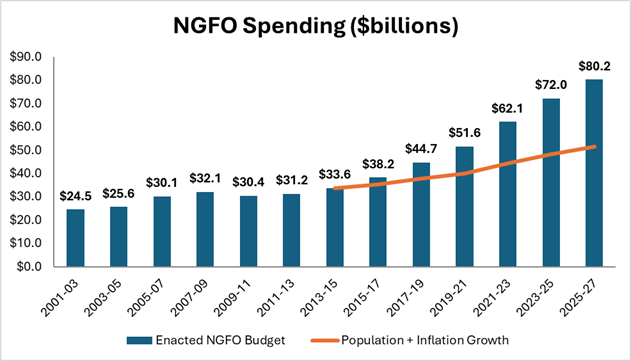
On the chart, the line is what spending would look like had it tracked population plus inflation, and the bars are what the Legislature actually spent. The gap between them is the part inflation and population cannot account for, the product of a long run of spending choices.
As the Washington Research Council noted, since 2021, the state has increased appropriations for new policy by a net of $15.5 billion (in addition to spending increases due to inflation and caseloads). This is why historically high tax increases, year after year, are not closing WA’s ongoing deficits.
The new income tax will not ride to the rescue either, and OFM says as much, telling agencies not to count on it. Revenue will not arrive until fiscal year 2029, the administration says 42% (likely closer to 30%) of the proceeds are already committed elsewhere, and the tax faces a court challenge and possible ballot measures.
The warning is fair as far as it goes, but the deeper trouble is that each new tax the legislature passes is not fixing their spending problems. Budgets get written to match ambitions rather than revenue, and when the money falls short, the answer is another tax that pays for more spending and sets up the next gap.
This is what keeps producing the shortfalls, not population and inflation growth.
Don’t let them rewrite the truth.