
The Washington State Department of Ecology finally released 2022 greenhouse gas emissions data for the state, three and a half years after that year ended. The data show a small decline in statewide emissions between 2021 and 2022, but the data aren’t good and show that the billions in spending and regulation have not delivered the promised emissions reductions to address what state politicians call an “existential crisis.”
There are four key takeaways from the report.
- Ecology leadership would not have released the report without our pressure. Their original plan was to release it at the end of the year – four years after the end of 2022. Our lawsuits, with legislators, forced this transparency.
- The report shows Washington’s climate policies are not working. Every sector saw GHGs increase except electricity and that was thanks primarily to an increase in hydropower due to high snowpack.
- We will not hit our 2030 targets. We would have to reduce emissions by the equivalent of one COVID-scale emissions reduction every other year between 2024 and 2030.
- Despite these failures, the Department of Ecology staff continue to engage in this political happy talk about us being “leaders” and that our policies are working. That denial is a big reason state policy continues to waste billions on policies that are not delivering emissions reductions.
Specifically, the report shows that total greenhouse gas (GHG) emissions declined slightly between 2021 and 2022 from the CO2 equivalent (CO2e) of 96.6 million metric tons (MMT) to 96.1 MMT/CO2e. This reduction if about one-half of a percent is due entirely to a reduction from electricity-related emissions. The report admits that the state is badly out of alignment with its own emissions targets.
The data in the report offers a stark contrast to the claims of politicians and Department of Ecology staff. Ecology Director Casey Sixkiller said the report showed Washington’s “leadership” on climate change. Instead, it shows how wasteful and ineffective the state’s policy has been, even as it has driven costs up.
The data themselves are interesting, but it is notable how the language of the report is intentionally misleading in several places – repeatedly portraying the failure of state policies as success.
For example, the report claims this report was released “ahead of schedule,” adding that it is “well ahead of the due date of the next biennial report in December 2026.” We believe that is false (the actual due date was the end of 2024), but even so, they are bragging that it only took them three and a half years from the end of 2022 to release the data instead of the four years they had previously promised.
Additionally, the Department of Ecology was in court last month saying they couldn’t release the data, even rejecting our proposal to release the 2022 data they admitted was available. Last month they were spending taxpayer dollars to block the release they are now trying to portray as magnanimous.
This report would not have been released without the pressure we applied by suing the Department of Ecology. Our lawsuit, joined by Rep. Mary Dye and Sen. Nikki Torres, and led by Citizen Action Defense Fund created this belated transparency.
Another example of how Ecology’s language doesn’t match the reality is the press release headline that claims “Clean energy is powering reductions in Washington’s carbon emissions.” Electricity-related emissions fell by the CO2 equivalent (CO2e) of 1.3 million metric tons (MMT).
Although the term “clean energy” is generally interpreted as wind and solar, the largest increase in low-carbon energy was hydro, not wind or solar. According to the state’s electricity mix report from the Department of Commerce, hydro production increased by 2.1million megawatt hours (MWh). Wind increased by just over 2 million MWh, which certainly contributed, but without the increase in hydro generation, statewide emissions would have likely increased.
The report itself hints at this, although avoids spelling it out explicitly. The authors note that “When hydropower production increases, it reduces demand for fossil energy use, and greenhouse gas emissions decrease.” That is what happened in 2022, due to above-average snowpack. The report goes on to note that “Hydropower production dropped by approximately 10% over 20 years (see 20-year trendline) and has dropped dramatically since 2017. This reduction in hydropower production has resulted in higher demand from fossil energy sources and larger greenhouse gas emissions in low precipitation years.”
The next bit of rhetorical sleight-of-hand is the report’s claim that “The state’s 2022 emissions were just 3.2% higher than the 1990 baseline that Washington was required to achieve in 2020.” The phrasing is odd because Washington was supposed to be significantly below the 1990 levels in 2022 to be on track to meet the state’s 2030 GHG target. Saying we were “just 3.2% higher” is actually an admission that we are failing.
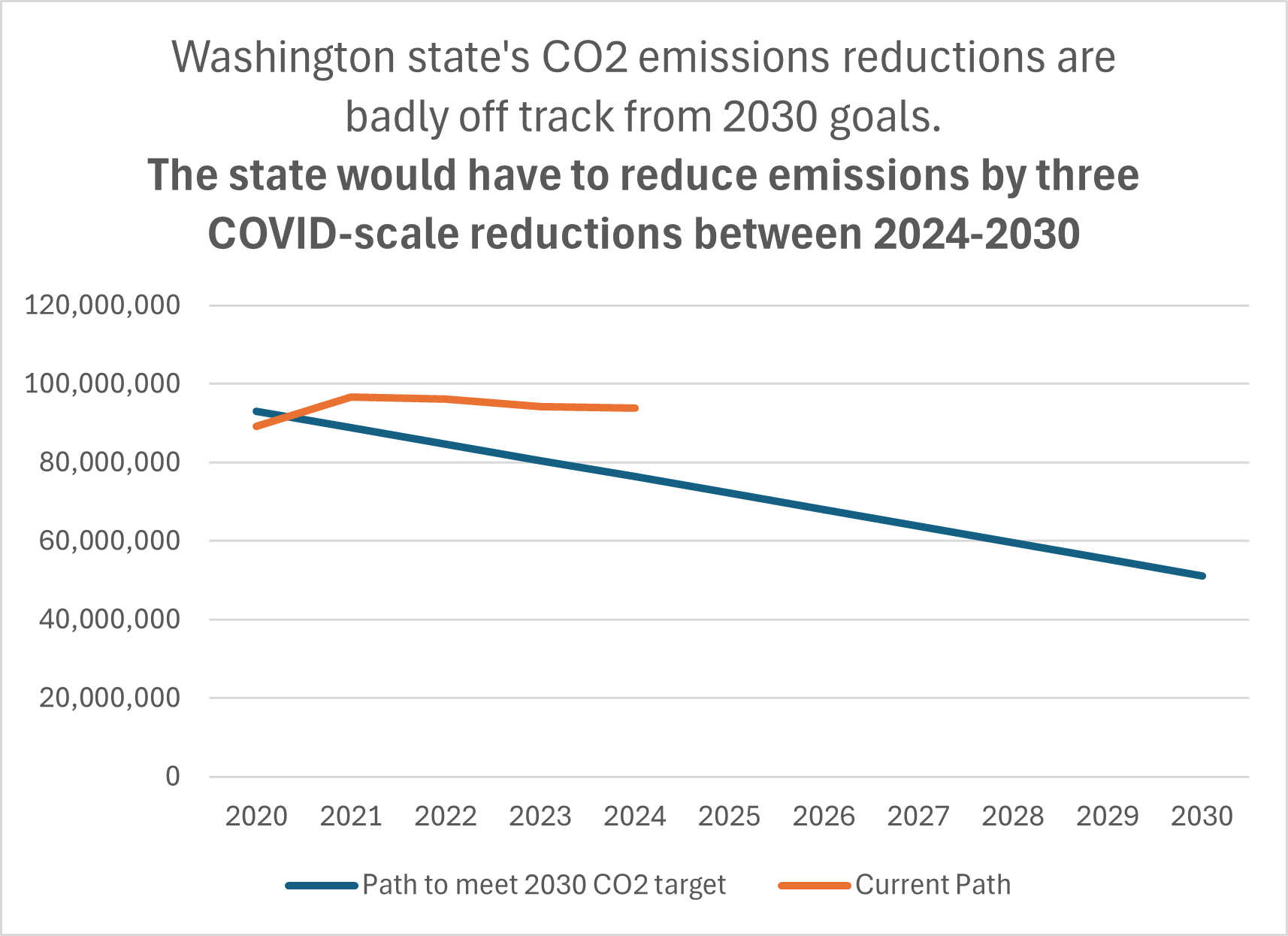 According to the state’s CO2e targets, we were supposed to be at the 1990 emissions level of 93.1 MMT/CO2e. Thanks to COVID, we met that goal but immediately jumped back to 96.6 MMT/CO2e in 2021, knocking us off the path to meet the 2030 goal.
By 2022, Washington’s emissions should have been about 85 MMT/CO2e instead of the 96.1 MMT reported by Ecology. Washington’s emissions are 13.4 percent higher than they should have been to meet the 2030 target. Ecology staff are attempting to whitewash the fact that we are badly off track.
As a result, it is virtually impossible to meet the 2030 targets. Using the 2022 numbers, state emissions would have to fall by nearly 6 percent per year every year between 2023 and 2030. Put another way, we’d have to reduce emissions by nearly one-half the amount emissions fell in 2020 due to COVID, every year for eight years.
It gets worse. The Department of Ecology has released partial data for 2023 and 2024, indicating that emissions fell less than three percent between 2022 and 2024. If those data hold, Washington state’s emissions would have to fall by 7.4 percent per year from 2025 to 2030, or more than one COVID-scale reduction every two years. This is not going to happen.
That failure is due to a combination of the fact that the targets were always arbitrary and unreasonable, as well as the fact that Washington politicians and bureaucrats prioritized politics over effective climate policy.
We have long advocated for requiring the state’s climate spending to be prioritized based on impact. The failure to do that has put the state in this position and there is no way to recover.
Despite that stark reality, the Department of Ecology continues to engage in the same political happy talk that put us in this position. Every year, the state’s emissions data shows we are failing to meet the targets and every year politicians and Ecology’s leadership claims Washington state is showing “leadership” and that our policies are working.
In Ecology’s release, Ecology Director Casey Sixkiller said, “Washington is a leader in fighting climate change. This report shows we continue to make progress in reducing emissions.” The report itself claims, “the reduction in total emissions since 2000, the year of peak emissions, constitutes notable progress.”
This is simply false. Not only is Washington failing badly to meet its own targets, it isn’t even a leader in emissions reduction.
Since 2000, Washington’s per-capita GHG emissions have declined by about 32 percent. Based on percentages, that ranks 25th in per-capita reductions – square in the middle of the pack. States like Florida, Georgia and Tennessee saw larger percentage reductions. One reason for the large percentage reductions is those states’ per-capita emissions were much higher than Washington’s in 2000. However, those states don’t have the advantage of our hydropower system and none of those states spent billions purporting to reduce GHG emissions. When it comes to emissions reductions, Washington is average.
One significant reason Washington’s results have been so poor is that politicians and agency staff aren’t honest about how ineffective our policies have actually been.
Once again, Ecology claims, “We expect future inventories will begin to show the collective impact of these policies and to provide more specific analysis of sector trends.” That echoes the 2021 GHG emissions report, which claimed “The collective impact of these policies will show up in future inventories.” In the 2018 emissions report, Ecology staff claimed, “Greenhouse gas emissions are up, but help is on the way,” promising “Yes, our carbon reduction policies are, in fact, working.” And in 2017, then-director Maia Bellon claimed, “our state’s carbon reduction strategies are beginning to pay off.” Contrary to that claim, emissions in 2022 were higher than in 2017.
It is clear that Washington will not meet the 2030 target but the Department of Ecology and some politicians cannot bring themselves to admit that failure, so they persist in the claim that their policies are working. They aren’t.
It is time to change Washington’s climate policy – one that faces the reality of the cost of existing policies, acknowledges the repeated failure of the current approach and creates accountability for the failure.