


If you've landed on this page you want the truth about state spending and the new state income tax..Whether you agree with our conclusions or not, hats off to you for being curious and seeking information!
Our goal here is to make it easy to find the answers to the most common questions surrounding Washington's new income tax and to provide you with the essential context you need to know about state spending. If you don't find an answer to your question here, email me at dboze@washingtonpolicy.org and we'll try to add your question to the mix.
Q: Does Washington need an income tax to raise revenue?
- The state has already raised billions in unexpected revenue with spending (adjusted for population and
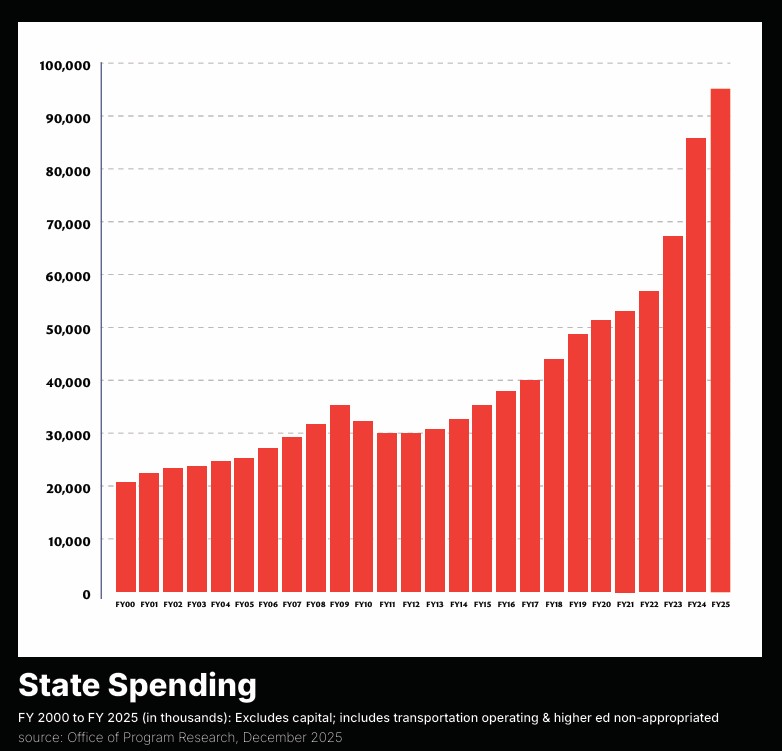 inflation) growing by almost 50 percent
 - Washington’s tax burden has risen sharply since 2013, despite prior commitments to avoid tax increases, with the state budget growing 51% and property tax collections increasing by 98%.
- The state’s business tax climate has deteriorated significantly, falling from 6th best in 2014 to 5th worst in 2025, discouraging new business creation
- Legislature Agrees to Increased Spending in Supplemental Budget
- In the latest Supplemental Budget, agencies that have seen double-digit budget growth every biennium gave back less than three hundredths of one percent.
- The conference report spends $80.2 billion. It drains $880 million from reserves, sweeps hundreds of millions from dedicated accounts, and inflates accounting assumptions well beyond historical norms.
- Run the math at the historical average of roughly 11% biennial spending growth (rather than the 2.8% in this budget) and the state will consume every dollar of projected income tax revenue in 2027-29 and still face a deficit of roughly $7 billion.
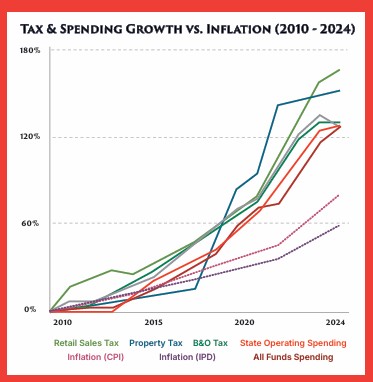
- Study shows 2025's record tax increases reduce Washington’s GDP growth and worker pay
- The study found that increases in the Business and Occupation tax (B&O) and applying the state sales tax to services are projected to reduce wages for skilled and unskilled workers by more than $2 billion in 2026, growing to nearly $6 billion in 2029.
- Washington’s 2025 tax increases are projected to reduce economic growth by half a percent of state GDP and cut wages by about $3.7 billion in 2026. The impact grows to a reduction of 1.2 percent in state GDP and $8.5 billion in lost wages by 2029.
Conclusion: Washington doesn't have a revenue problem, it has a spending problem. And while the state faces challenges in many areas, we are not getting the results we should expect for the investments we are making. Imposing an income tax feeds that problem and strips the state of its competitive advantage.
Q: Are the rich not paying their fair share of taxes? Are "the poorest people in this state...carrying the rest of the state on their backs in terms of taxation?"
The "Fair Share Myth" That Won't Die
- According to the Department of Revenue (DOR), taxpayers earning over $243,000 pay approximately $41,020 in state and local taxes per biennium. Those in the lowest bracket ($16,000-$32,000) pay an average of $7,206.
- The data shows that the top income groups contribute vastly more in total tax dollars than lower-earning brackets.
- Low-income families do pay a higher share of their income in taxes but when you look at total dollars
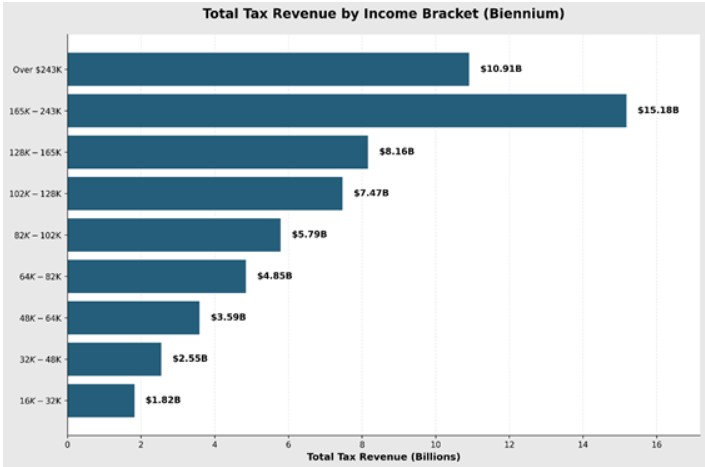 collected, higher earners contribute the overwhelming majority of tax revenue, contributing tens of thousands of dollars more per year than anyone else.
 - The truth is that both low-earners and high-earners are overtaxed. Low-income earners shouldn’t be paying over 14% of their salary in taxes.
- If you could tax your way to prosperity on the backs of high earners, California would be budget nirvana.
- Despite many billions in surplus revenues and many, many public speeches extolling concern for the tax burdens carried by the middle and lower income families, the Legislature has not reduced the state sales tax rate since 1982.
Conclusion: The poor are not "carrying the rest of the state on their backs" and the rich are paying a substantial majority of the total dollars Washington collects. The "fair share" arguments are a distraction from the harms of the income tax and the failure of the Legislature to cut the sales tax to provide relief.
Q: Will an income tax targeting "millionaires" spread to target middle class incomes? And how does the volatile nature of income taxes add to the risk of their expansion?
- When the income tax was passed, an amendment would have limited the future scope of the tax to millionaires, but that restriction was rejected by the majority.
- The state's most recent $2.3 billion shortfall was larger than the total tax payments from all households in the lowest income bracket. If record-breaking contributions from high and middle earners are not enough to prevent a deficit, the problem is one of spending, not a lack of "fair share" revenue.
- Washington has collected billions in unexpected tax revenue over the past several years. Two years ago, we had a record-shattering tax increase. New taxes including payroll and capital gains taxes have been imposed. This year, taxes were increased again and an income tax was passed. Even IF the income tax survives court challenges, WPC estimates the state will face a massive $7 to $10 billion deficit in the next biennium, further perpetuating the cycle of unrestricted spending determining tax levels.
- In previous income tax debates, advocates already cited thresholds dramatically lower than a million dollars.
- Other state income taxes and the federal income tax started at high earners and spread to lower tax brackets. Can anyone imagine Washington would be the one state to resist?
- Income taxes (including capital gains income taxes) are volatile sources of state revenue.
- Credit rating agencies like S&P Global Ratings have consistently identified Washington's lack of a state income tax as a key credit strength (Washington's "sales-tax-based revenue structure...has demonstrated less sensitivity to economic cycles than that of income-tax-reliant states," they noted.).
- When S&P and Moody's assign Washington high ratings because of our income-tax-free, stable tax structure, state taxpayers pay lower interest rates on the bonds that fund schools and highways. Lower interest rates mean more tax revenue funds services rather than debt payments.
- The trade-off with an income tax is we would replace one of Washington's most valuable fiscal assets, revenue stability, with a system that has consistently proven to be less stable.
- State budgets that depend on volatile sources like income taxes inevitably face large swings in state revenues during market downturns, leading to either major spending cuts, a broadening of the tax base to expand potential revenue collection, or both.
Conclusion: From the federal government to state governments, income taxes that start by targeting higher incomes end up expanding to broader tax bases when volatility and revenue declines or spending pressures inevitably hit. Washington's Legislature is in a cycle of unsustainable spending that makes a "need" for higher future taxes virtually inevitable.
Q: Will an income tax make Washington less competitive in attracting and retaining new businesses and jobs?
- Washington's business tax ranking collapsed between 2014 and 2025, with our state going from the 6th best for business to 45th.
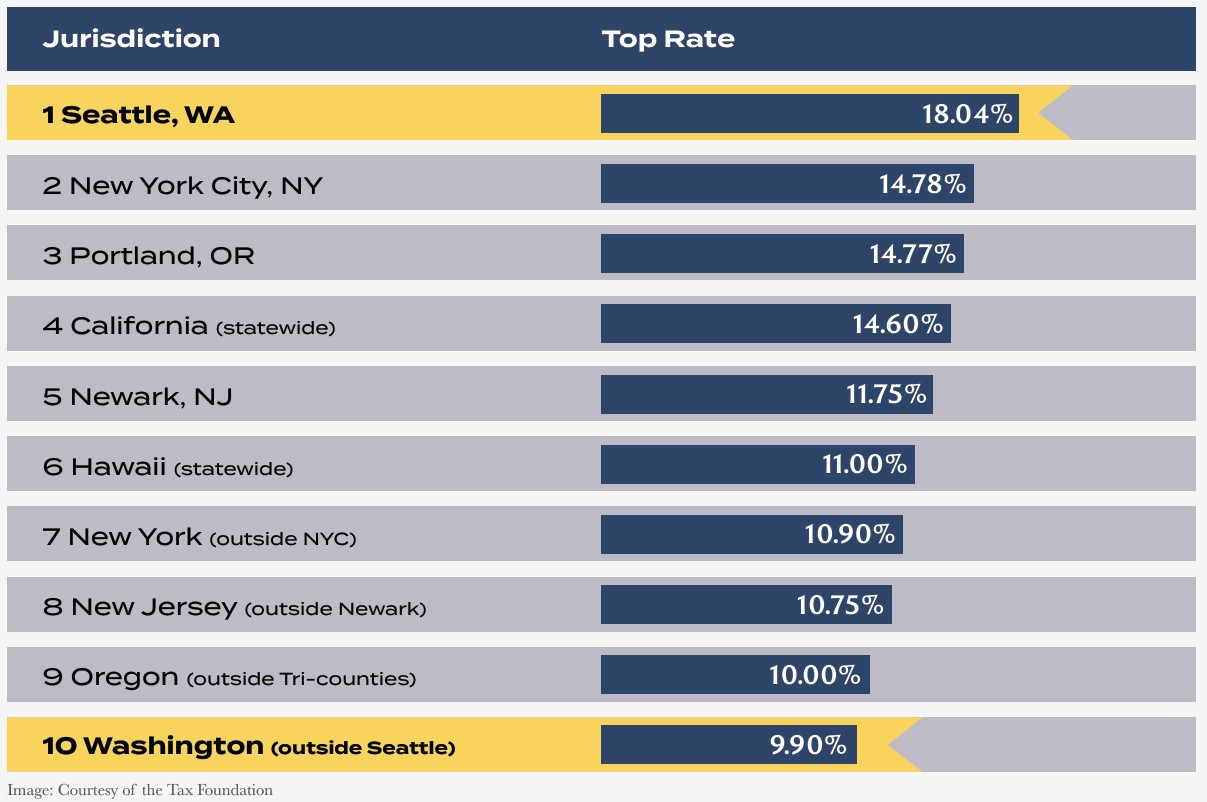
- Even after years of surplus revenue amounting to billions of extra dollars, the biggest tax increase in state history, another tax increase, new payroll taxes, a new capital gains tax, and a new income tax, Washington faces a looming $7 to $10 billion dollar deficit. As indicated by the below Tax Foundation chart detailing where we land with the presumption the income tax survives, we are already amongst the highest taxed areas and our competitive position is compromised.
Sign up for our newsletter below for more information about the state income tax, state spending and key state policy news!