



According to AAA, Washington state’s average gas price has again climbed above $5 per gallon, one of only three states with a price that high.
This briefing answers three claims made by Washington politicians and state agencies about what is behind Washington’s high gas prices.
1. Governor Ferguson: The war in Iran increasing gas prices. True.
2. Senate Republicans: Washington state’s climate law is increasing gas prices. True.
3.Dept. of Ecology: There is no “clear relationship between the price of carbon and the price of gas.” False.
The war in Iran is increasing gas prices.
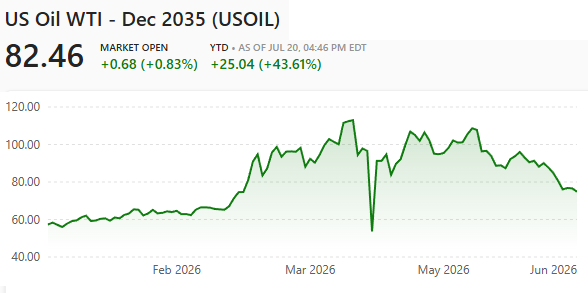 The war in Iran has increased the price of a barrel of oil from about $60 a barrel to over $80 a barrel which has a direct impact on the price of gas at the pump. In March, as the war began, California Department of Energy estimated crude oil accounted for $2.33 for every gallon of gas. By May, that amount jumped 25 cents per gallon to $2.58. Additionally, as oil prices increase, so too do other costs in the supply chain.
The increases aren’t limited to Washington state. According to GasBuddy, the average price of gasoline nationally jumped from about $3 per gallon at the beginning of March to about $4 a gallon today. That points to concerns about global oil supply impacted by the war.
But that doesn’t address issue of why Washington’s gas prices are so much higher than other states, including Oregon and Idaho.
Washington’s climate law is also increasing gas prices.
Two key factors are driving Washington’s gas prices above neighboring states. First, Washington’s gas tax is 56.5 cents per gallon, third highest in the nation. It is 16.5 cents per gallon more than Oregon and 24.5 cents per gallon more than Idaho.
The state’s climate law – the CCA – also increases prices significantly. Currently, the price of CO2 allowances ($64.56/metric ton of CO2) adds about 52 cents per gallon.[1]
Staff at the Department of Ecology dispute this, claiming, “We haven’t seen a clear relationship between the price of carbon and the price of gas.” This is false and is contradicted by the Department of Ecology’s own study, gas price experts, the State of California – whose CO2 market Washington is joining – and the Inslee Administration.
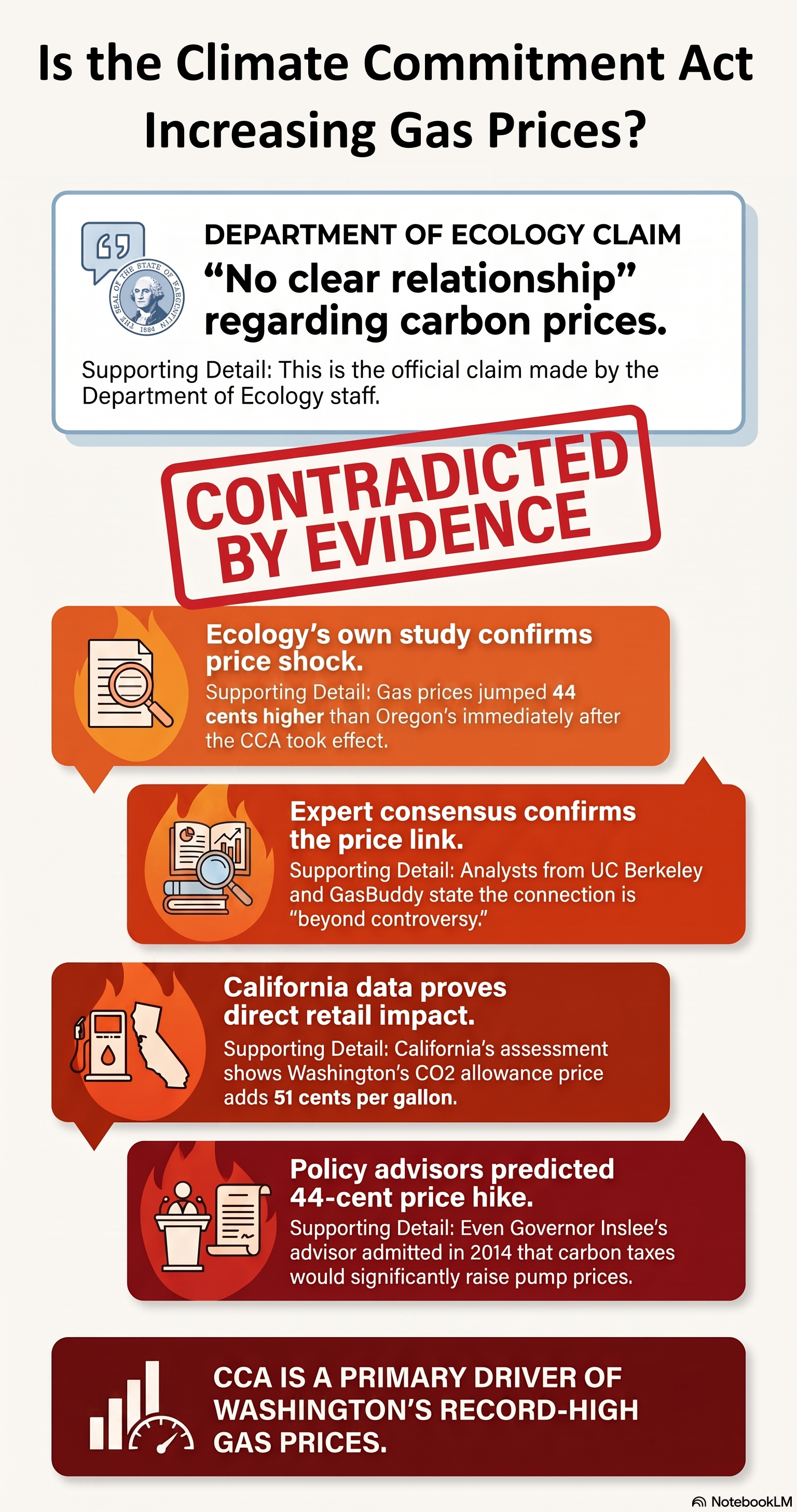 A study released this year and commissioned by the Department of Ecology notes that there was a “shock” to Washington’s gas prices when the CCA took effect in 2023. Ecology’s study shows gas prices in Washington went from being the same as Oregon in December 2022, to about 44 cents per gallon higher in 2023 – exactly the amount the CCA’s CO2 price implied and almost exactly what we claimed at the end of 2023.
- Other experts agree. Severin Borenstein of the University of California Berkeley, who helped California develop their CO2 cap-and-trade system, told The Seattle Times that “it is beyond controversy that Washington’s carbon-pricing program contributed to the jump in prices.” Patrick deHaan, head of Petroleum Analysis for GasBuddy, also told MyNorthwest that “the link between the cap-and-trade program and gas price increases is clear,” adding that “Washington state has seen its prices going up because of the new system. And now Oregon’s gas prices are on average over 45 cents a gallon lower.”
- The State of California Legislative Analyst’s Office released an assessment of the “retail impact” of their tax on CO2 emissions. They estimated an allowance price of $29.27 per metric ton of CO2 adds 23 cents per gallon. Washington’s current allowance price is $64.56 per metric ton of CO2 which calculates to 51 cents per gallon.
- Former Governor Inslee’s own policy advisor admitted in 2014 that a CO2 tax would increase gas prices by 44 cents per gallon with a CO2 price lower than Washington currently has.
Department of Ecology staff have a history of make claims that are either inaccurate or intentionally misleading. In 2023, the Department of Ecology’s web page claimed the CCA would add “an additional 5 cents per gallon in 2023.” When Washington’s gas prices jumped to the highest in the nation in 2023 and 45 cents above Oregon’s price, Ecology quietly removed that claim from their web page, scrubbing mention of the impact of the CCA on gas prices.
How Washington state policymakers can lower gas prices.
- Suspend the CCA while prices are high. This would reduce current gas prices by about 52 cents per gallon. Legislators would also have to adjust the state’s CCA compliance schedule. That should be done anyway because the current 2030 target is unscientific, arbitrary and would require CO2 reductions equivalent to more than two COVID-level declines.
- Cap the price of CCA permits at California’s current price. The current price of $28.81 per metric ton equates to 23 cents per gallon – a reduction of 28 cents per gallon from current prices. Washington hopes to join California’s market next year, so this would align our prices.
[1] To translate the cost of a metric ton of CO2 to a gallon of gas, the EPA, California Legislative Analyst’s Office and environmental economists multiply the price of a metric ton (MT) by 0.88%. A CO2 price of $10/MT equates to 8.9 cents per gallon. Washington also has a 10% ethanol mandate, which reduces the price by 10%, which reduces that to 8 cents per gallon.