


When Washington’s tax on CO2 emissions dropped significantly last month, I predicted that gas prices would decline compared to neighboring states. I tweeted:
“Well, with such a large decline - 20 cents per gallon - we can see if the gap between Washington and neighboring states like Oregon and Idaho, gets smaller over the next month. It will take some time for prices to filter through the system, so let’s all meet back here in a month and see what happened.”
It is one month later, and we have seen the gap between Washington and neighboring states fall.
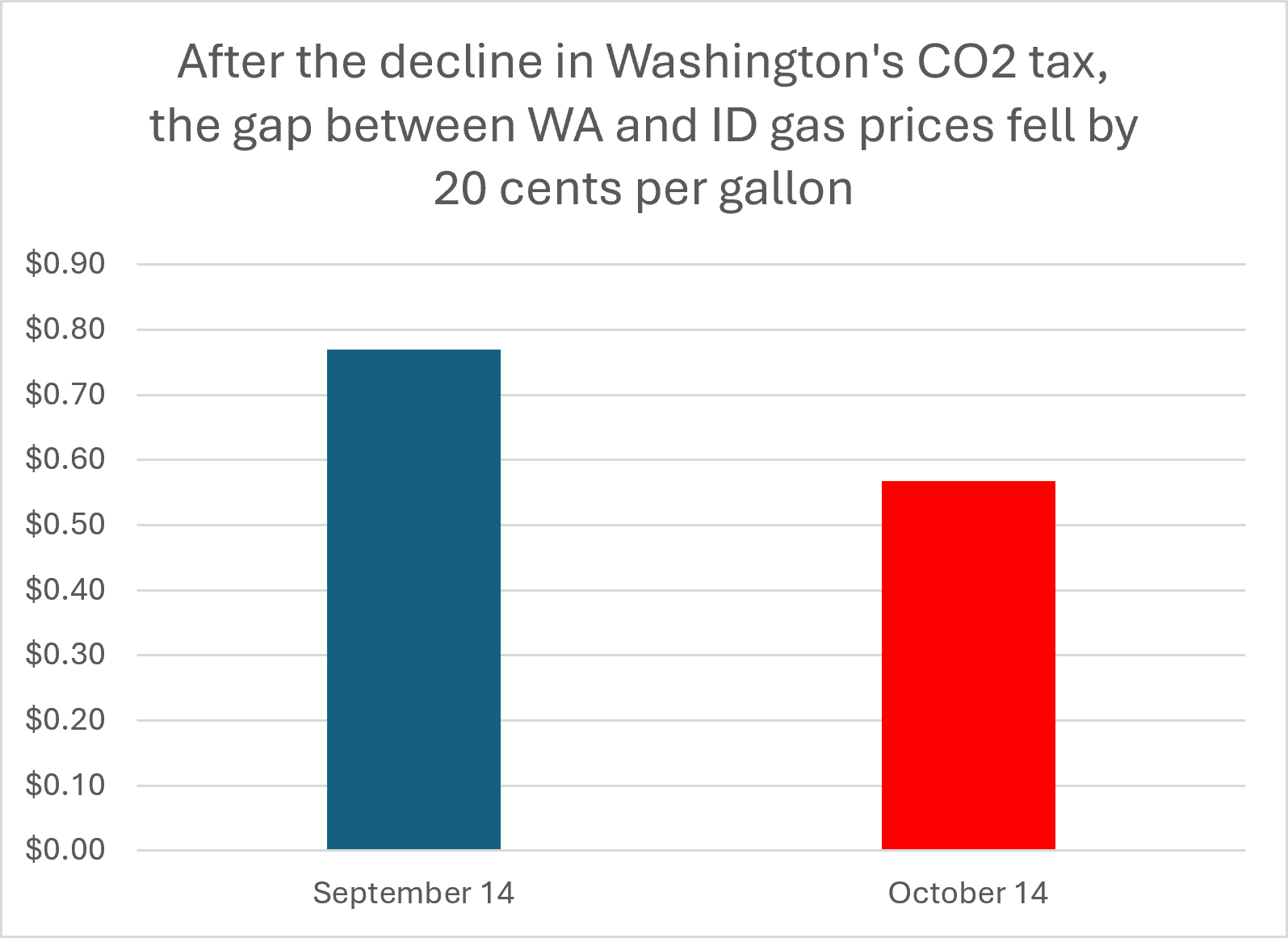 According to AAA, one month ago the difference between the average gas price in Idaho and Washington was 77 cents a gallon. Today, it is 57 cents per gallon. The margin fell by 20 cents per gallon, exactly what the change in the CO2 tax would imply.
The comparison to Oregon, however, is very different. The gap between the two states declined by just one cent. What is going on?
In 2023, when the CO2 tax was first implemented in Washington, Oregon provided a good baseline to compare the states because the price was virtually identical in December of 2022, right before it took effect. Since then, however, Oregon’s climate policies have changed making the comparison more difficult. In December of last year I noted that, “as time goes on, the comparison to Oregon gets more noisy. … Since then, both states have added a variety of regulations and the price of Oregon’s low-carbon fuel standard has skyrocketed, making comparisons more difficult.”
For example, the price impact of Oregon’s low-carbon fuel standard can change dramatically. The impact of that tax is 6 cents per gallon higher than last year. We don’t have cost data for October, so we don’t know if the change in the LCFS price is contributing to the lack of change between the two states. But it is very unlikely that an increase in the price of the LCFS is what is contributing to the lack of change.
It is unclear what other factors caused the lack of change between the two states’ gas prices. Some could be internal to fuel suppliers. There are also probably policy issues in Oregon that I am not aware of. It could simply be that policy and market uncertainty is causing some companies to hedge.
The remarkable function of price signals is that they capture complexity that is difficult to understand from the outside. The problem with that opacity is that it allows politicians to fill the gap of information with demagoguery.
Earlier this year, the Department of Ecology once again claimed there is no “clear relationship between the price of carbon and the price of gas.” That not only contradicts their own studies but relies on claiming that the fact that Washington and Idaho’s gas prices declined by exactly the amount implied by the reduction is a pure coincidence.
The good news is that Washington’s CO2 price is declining, reducing the harm to families and businesses in the state. The bad news is that state politicians and agencies will continue to lie about the damage being done by the state’s tax on CO2 emissions.