




Over the past two decades, Washington’s economy has grown rapidly under a tax system without a broad-based personal income tax. People and employers moved here, the economy exploded, and state tax collections climbed. Every governor since 1985 has been a Democrat, and Democrats have controlled both chambers of the Legislature for most of those two decades. This is the tax system they governed under and largely chose, and it came to the benefit of those who started businesses and live here today.
That tax system has changed rapidly over the past ten years, driven largely by the state's own spending choices. The operating budget has risen from $33.6 billion in 2013–15 to $80.2 billion today. When even strong revenue growth could no longer keep pace with their spending demands, lawmakers and their pro-tax allies increasingly argued that Washington’s tax code was unfair because wealthy households were not paying their “fair share.” That argument helped produce a capital gains tax, higher business taxes, and now a 9.9% income tax.
The consequences of these choices are dire. Washington recorded a net loss of 5,875 residents earning $200,000 or more in the latest IRS migration data. The state’s tax-competitiveness ranking fell from sixth in the 2014 index to 45th in the 2026 index. Both trends have unfolded as lawmakers imposed new taxes on high earners and businesses. It is a poor time to pretend that the loss of high earners and the deterioration of Washington’s business tax climate are unrelated to the choices lawmakers are making.
The main evidence offered for continuing this shift is the Institute on Taxation and Economic Policy’s (ITEP) Who Pays? study. Advocates of higher taxes cite its ranking of Washington as the nation’s second-most regressive tax code as proof that the system must change. The study measures how the tax burden is distributed, but it does not measure the total burden, economic competitiveness, or whether a tax system is working.
ITEP’s conclusions fail a basic common-sense test. It asks us to believe Tennessee, Texas, Nevada, and Florida are doing tax policy wrong, while California, Minnesota, New York, and New Jersey are doing it right. Yet people and income keep moving in the opposite direction. You do not need a complicated study to recognize that a ranking this disconnected from how people actually behave is not a reliable guide to tax policy.
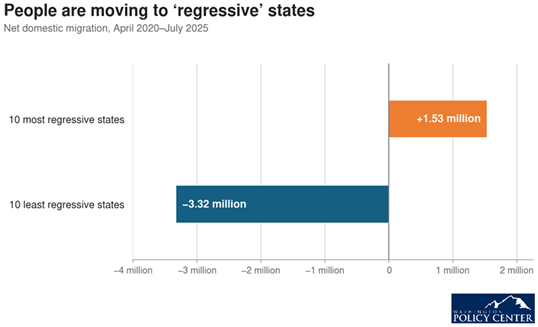
From April 2020 through July 2025, according to the US census, the 10 states ITEP ranks most regressive gained a combined 1.53 million net domestic migrants. The 10 least regressive states lost 3.32 million. Six of the 10 most-regressive states gained residents through domestic migration. Among the least-regressive states, only Maine and Vermont did.
Federal tax-return data shows income moving in the same direction. During IRS filing years 2022 to 2023, the 10 most-regressive states had a net gain of $21.9 billion in adjusted gross income carried by interstate movers. The 10 least-regressive states lost $29.8 billion.

Business relocation is harder to measure consistently across all states, but employment and output show where economic activity is growing. From 2019 through 2025, median real GDP growth among the 10 most-regressive states was 19.1%, compared with just 11.2% among the 10 least-regressive states. Median payroll employment grew 6.6% versus 1.6%, and median real GDP per resident grew 13.1% versus 8.8%.

Lower regressivity also did not mean a lower tax bill. Using the Tax Foundation’s 2022 resident-burden estimates, the 10 least-regressive states averaged 12.45% of income, compared with 9.68% for the most-regressive states. That is 29% higher. Average burden per resident was $8,302 versus $5,790, a 43% difference.

These real-world outcomes belong in any honest debate about taxes, and they don’t exist today among the majority party and its supporters. Washington lawmakers can debate how taxes are distributed, but they also must account for how much people will pay, what changes to the tax system does to the economy, and whether it makes Washington a better place to live, invest, and create jobs. After years of rapidly increased spending, tax increases, and worsening outcomes, Washingtonians are finding out that the new way of doing things isn’t working.