


Give

What are the priorites for a revised Sound Transit plan? Start by asking the right questions

About the Author
Charles Prestrud
Director, Coles Center for Transportation

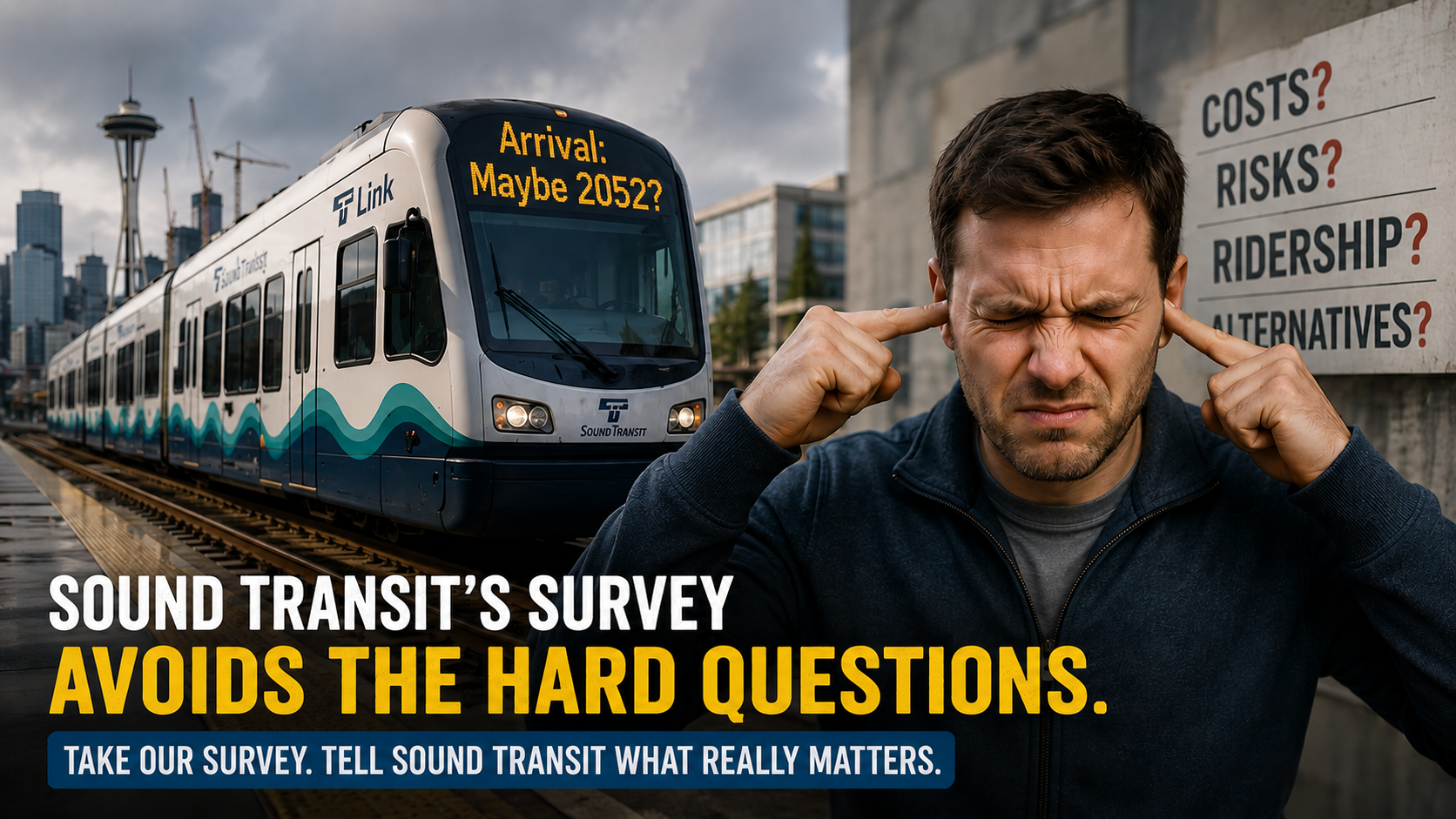
Sound Transit has conducted an online survey ostensibly to obtain public input on choices the board will be making in response to the agencies' $34 billion budget gap. However, the questions posed in the survey steer clear of key issues and appear to have been crafted to support the approach taken in the “enterprise initiative” Sound Transit has used to develop revisions to the ST3 plan.

For example, one survey question asks “how best to invest in our system”, but expanding express bus service isn’t one of the choices listed even though it is the primary alternative to light rail. Another question lists principles that are supposedly guiding Sound Transit's decision-making. One principle is ”Protecting public investments”, which is described as “…being careful stewards of public resources, seeking cost savings and efficiencies, maintaining strong oversight and accountability, and understanding trade-offs.” That is an amazing statement coming from an agency that has consistently gone billions over budget, years behind schedule, and is proposing light rail projects with the world’s highest per-mile costs. It is hard to reconcile such failures with their claim of “maintaining strong oversight and accountability”.

After nearly thirty years of busted plans and broken promises the public probably does have opinions on these issues, but the survey provides no information about costs, risks, ridership, or commitments in the 2016 ballot measure, so no factual basis has been provided for weighing the trade-offs. That being so, results of Sound Transit’s non-scientific survey, which reads more like a push-poll, may tell the board what they want to hear but it will shed very little light on the key issues.

Perhaps even more revealing are the important questions the survey didn’t ask. To help fill in where the Sound Transit survey falls short, the Washington Policy Center invites readers to answer the following questions. Results will be sent to the Sound Transit board for their consideration.


Sound Transit ST3 Survey

 *  

Sound Transit has admitted the cost of the ST3 plan exceeds estimated revenue by $34 billion. Should Sound Transit proceed with a scaled back plan that fits the budget or give voters the opportunity to approve a revised plan?

 Proceed with a scaled-back plan
 Put a revised plan on the ballot
 
 *  

To help finance the plan’s increased cost Sound Transit has sought authority to issue bonds with 75-year maturities. This would push billions of dollars of debt onto future generations and greatly increase total financing costs. Do you support allowing Sound Transit to issue 75-year bonds?

 Yes    No
 
 *  

When Sound Transit has put measures on the ballot they have said taxes would be rolled back once construction of the system was complete. For the ST2 plan the tax roll-back date was 2038.

The revised ST3 plan now under consideration would extend construction to 2052 and obligations for debt repayment for decades beyond. This will preclude a tax roll-back in the foreseeable future. Would you prefer a plan that rolls back taxes sooner if it meant deleting the lowest ridership light rail extensions?

 Yes    No
 
 *  

The population, employment and ridership assumptions used to develop the ST3 plan are a decade out of date and no longer valid. The dispersion of jobs across the region, more working from home, and rapid population growth in areas light rail won’t reach have caused transit ridership forecasts to be reduced. Even with full build-out of the Sound Transit plan only 2% of daily person-trips in the region are forecast to be on light rail by 2050. Would you support a revised plan that expands Bus Rapid Transit and other flexible modes rather than light rail if that results in higher ridership, lower costs, service to more of the region, and less neighborhood disruption?

 Yes, Sound Transit should invest in the most cost-effective system regardless of mode
 No, light rail is what voters were led to expect so that is what Sound Transit should build
 

ST3 Priorities

The ST3 plan approved by voters in 2016 included a $54 billion cost estimate, a 2041 completion date, and a commitment to maintain subarea equity to ensure system benefits are distributed across the region in proportion to revenues collected. Sound Transit has said the revised plan should “keep faith with voters”, but the proposals now under consideration far exceed the 2016 budget, extend construction beyond 2050, and modify subarea equity to the disadvantage of outlying parts of the region. In your opinion, which ST3 commitments are most important for “keeping faith with voters”?

Please rank the following by dragging the bars in order, the top being the highest priority and the bottom being the lowest:

  • Staying within the original budget
  • Completion of construction by 2041
  • Maintaining subarea equity
  • Building light rail


This is the ouput of the prior question. For best results, do not edit the field.


* Required


Sign up for the WPC Newsletter


Share