


Years ago, I ran a statewide charity for people who couldn’t afford prescription medicines. Our small staff worked the sometimes-long hours necessary to help people get the medicine they needed to survive. One of our employees had health issues himself and was passionate about helping others with illnesses.
We didn’t have a lot of money, and the pay was adequate but not great. While I was executive director, I didn’t get paid for a full year (I had other sources of income) because I worried that we wouldn’t make payroll.
The sad reality is that today Washington state is engaged in a war on the kind of charity I ran. If we had to face the rules about to take effect in the state, we would have simply closed the doors and the people with asthma, mental illness and other diseases would have gone without the medicines they needed.
Washington’s Medicaid program would occasionally send people to us who needed prescription medicines because they had been denied state care. There is a cruel irony that state government consistently underfunds its own healthcare programs while forcing nonprofits like the one I ran to pick up the slack. Government created demand for our charity and government regulations may make it impossible to serve that need.
In the near future, charities like the one I ran will face attacks on several fronts that make it difficult for them to raise the funds they need to operate and increase the cost of providing those critical services. The magnitude of those attacks is becoming stark.
Sounding the alarm for Washington state charities, the CEO of Seattle Children’s Hospital warned that the state’s new income tax could do serious damage to philanthropy.
Dr. Christopher Longhurst warned that the donation cap in the income tax would make it harder to get the large donations that are critical to providing care for seriously ill children. “Capping the state charitable deduction at $100,000 in Washington creates a strong disincentive for high-impact philanthropy, ultimately hurting the communities and organizations that rely on charitable support,” he wrote.
He isn’t the only one warning about the damage an income tax would do to charitable giving.
An analysis of the income tax argued that wealthy donors who move out of the state to avoid the tax may feel they have to completely stop donating in Washington to prove to the state Department of Revenue they aren’t subject to the tax. If continued donations to Washington charities can be used by the state to prove a financial connection to the state – and, therefore, tax liability – the author notes, “When substantial tax is at stake, donors may want as little uncertainty as possible.” If a donation to a Washington charity could trigger a massive tax liability, why risk it?
But this isn’t the only concern that Washington charities face.
In 2028, all employers, including non-profit organizations, must either pay employees a salary of $93,288 a year or pay overtime for any time worked beyond 40 hours a week.
Everyone wants to be paid well, but people working at charities understand they are there for the mission. On many occasions my staff responded after hours or on weekends because someone needed help. Some weeks were incredibly busy while others were quiet. Imposing a one-size-fits-all approach makes it difficult or impossible for charities to meet the changing demands of helping people who are suffering.
The combination of punishing the philanthropists who fund so much of Washington’s charitable sector and dramatically increasing the costs to run a charity is putting non-profits in a vise of government regulation that is squeezing the life out of these necessary organizations.
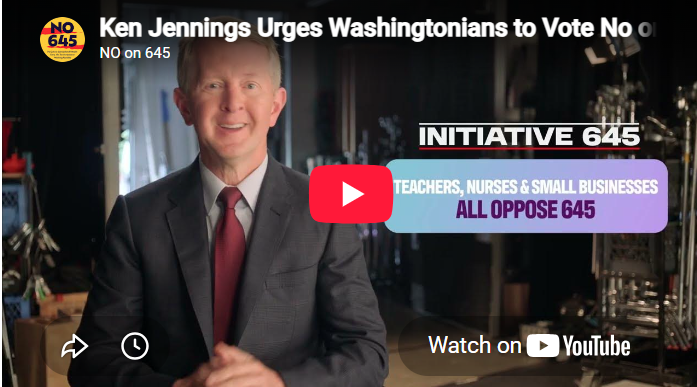
If voters reject I-645 and thus the destructive income tax remains in place, the legislature must, at minimum, significantly increase the charitable donation limits.
Even so, this will not fix the problem entirely because the tax itself is contributing to a flood of people leaving the state. IRS data show that in 2022 Washington was already losing more high-income taxpayers than 45 other states. This year, there have been many indications that the flow has accelerated, including real estate analysts predicting that Washington state will have the largest “downward forecast” in housing prices in 2027 due to a huge number of people putting their house up for sale.
Damage has already been done. The income tax and wage regulations will compound the harm.
Charities are a critical part of filling in the gaps of the social safety net, creating cultural opportunities and delivering assistance that is far more effective than government programs. Washington’s policies are damaging that important sector, choosing government bureaucracy and largesse over compassionate community action.