
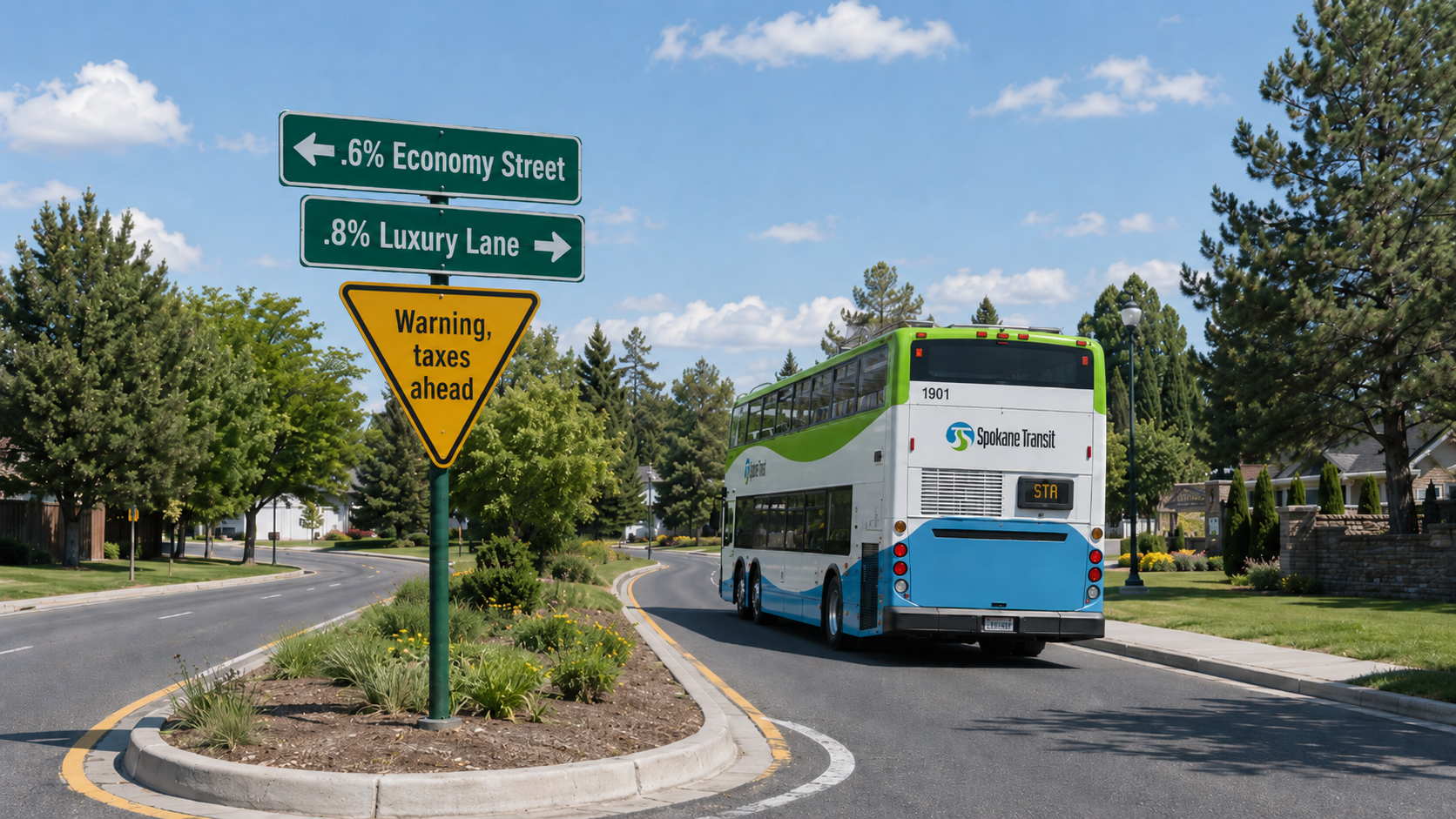

The August 4th ballot will present voters in the Spokane area with a proposal to renew a .2% sales tax that is set to expire at the end of 2028. If passed, Proposition One would extend the existing .2% tax for twenty years, generating about $30 million per year for Spokane Transit. The .2% tax is in addition to the permanent .6% sales tax that Spokane Transit receives. In 2025 the agency's total revenue was a little over $160 million.
Spokane Transit is unusual in presenting voters a tax increase that sunsets. Other transit agencies in Washington have insisted on permanent tax increases, where, once approved, voters are never given another opportunity to vote regardless of how much an agency’s circumstances have changed.
In the materials describing the proposal Spokane Transit emphasizes that 26 of the 27 projects funded by the tax approved in 2016 have been completed and ridership now exceeds the pre-COVID level. Those are commendable accomplishments, especially compared with other transit agencies in the state, most of which have not fully regained ridership lost during the COVID pandemic, and some of which are struggling with years of delay and very large cost overruns implementing projects. However, looking forward it is less clear what renewal of the tax would achieve in terms of Spokane Transit’s adopted performance goals or whether it would increase ridership and operating efficiency.
Cities, counties, and other public agencies face growing need for a wide array of public services, including police and law enforcement, community mental health and substance abuse treatment, and street maintenance, to name just a few. Spokane Transit could help voters already suffering from tax fatigue decide whether the proposed .2% tax is a priority by addressing the following questions:
Cost-effectiveness – Since 2016 Spokane Transit has expanded service by 35%, but ridership has only increased by about 6% and the number of passengers carried per service hour has declined from 25.8 to 19.4. The inflation adjusted operating cost per passenger has risen by 34% to about $10 per boarding. This trend of diminishing cost-effectiveness is an industry-wide problem. Spokane Transit has done a better job of managing costs than most agencies in Washington, but costs continue to rise and bus service now costs nearly $200 per hour while generating only about $14 in fare revenue. It isn’t obvious how the additional revenue provided by Proposition One would address the unfavorable cost and productivity trends.
Financial reserves – Spokane Transit has prudently avoided debt (which is more than can be said for some other agencies). As a result of their conservative approach and extensive Federal support Spokane Transit has accumulated a large surplus. At year-end 2025 the agency reported total unrestricted reserves of $248.3 million, which is roughly double Spokane Transit’s annual operating expense. This begs the question of whether the .2% tax increase is needed and whether current service levels could be maintained with a .1% tax and slowly drawing down some of the surplus.
Ten-year Strategic Plan – In 2025 the Spokane Transit board adopted Connect 2035, the agency’s ten-year strategic plan. The agency website indicates that renewing the .2% tax will enable implementation of the services and facilities identified in the plan as well as maintaining existing services. However, it does not explain why a twenty-year tax is needed to pay for a ten-year plan, especially one that doesn’t involve issuing debt. Consistent with the 2016 tax increase, wouldn’t it make sense to allow a vote on renewal of the tax when the ten-year plan has been completed?
Shifting demand for mobility – The dramatic drop-off in ridership during the COVID pandemic was a shock to every transit agency in the U.S. Spokane Transit’s ridership has rebounded and now exceeds the level immediately before COVID. They are one of only a few agencies in the state that can make that claim, but ridership is still below the peak of nearly 11.5 million passengers carried in 2014.
The pandemic accelerated remote work, online shopping, and many other internet-based activities with far-reaching effects on travel behavior that are still unfolding. The Connect 2035 plan identifies a number of facility and service improvements, but aside from a few mobility-on-demand van service pilots in selected areas, it says little about how Spokane Transit will respond to changing demand. For example, autonomous vehicle technology is advancing rapidly and robotaxis are likely to offer on-demand, point-to-point service in many cities before 2035. That is expected to have an affect on transit ridership while also creating opportunities for new forms of public transportation. Few transit agency plans address the impacts from technological advances or the shifts in travel behavior that are already becoming apparent. Voters would benefit from a clearer explanation of what their taxes would fund and how Spokane Transit will adapt to the emerging mobility landscape.
Timing – Every public agency prefers budget certainty, but the existing .2% tax doesn’t expire until the end of 2028, nearly two and a half years from now. Waiting until next year would give the public and policy makers more time to sort out their priorities, and to provide a clearer picture of economic trends. Right now there is more uncertainty than usual regarding the economy, Federal funding, fuel prices, the practicality of electric buses, and emerging transportation technologies. We won’t have definite answers to all those questions a year from now, but there will be more certainty with regard to Federal funding and other important budget considerations. Spokane Transit’s strong financial position gives the agency flexibility to hold off on the tax renewal until closer to the date when the existing tax expires.
A comparison of performance data shows Spokane Transit is among the very best transit agencies in Washington. They also deserve credit for giving voters the choice of renewing a portion of the sales tax rather than insisting on imposing taxes in perpetuity. However, to make an informed decision voters may want to know more about what renewing the tax would accomplish, in particular, whether the additional funding will lead to a more efficient transit system, or simply a larger public expenditure with higher costs.