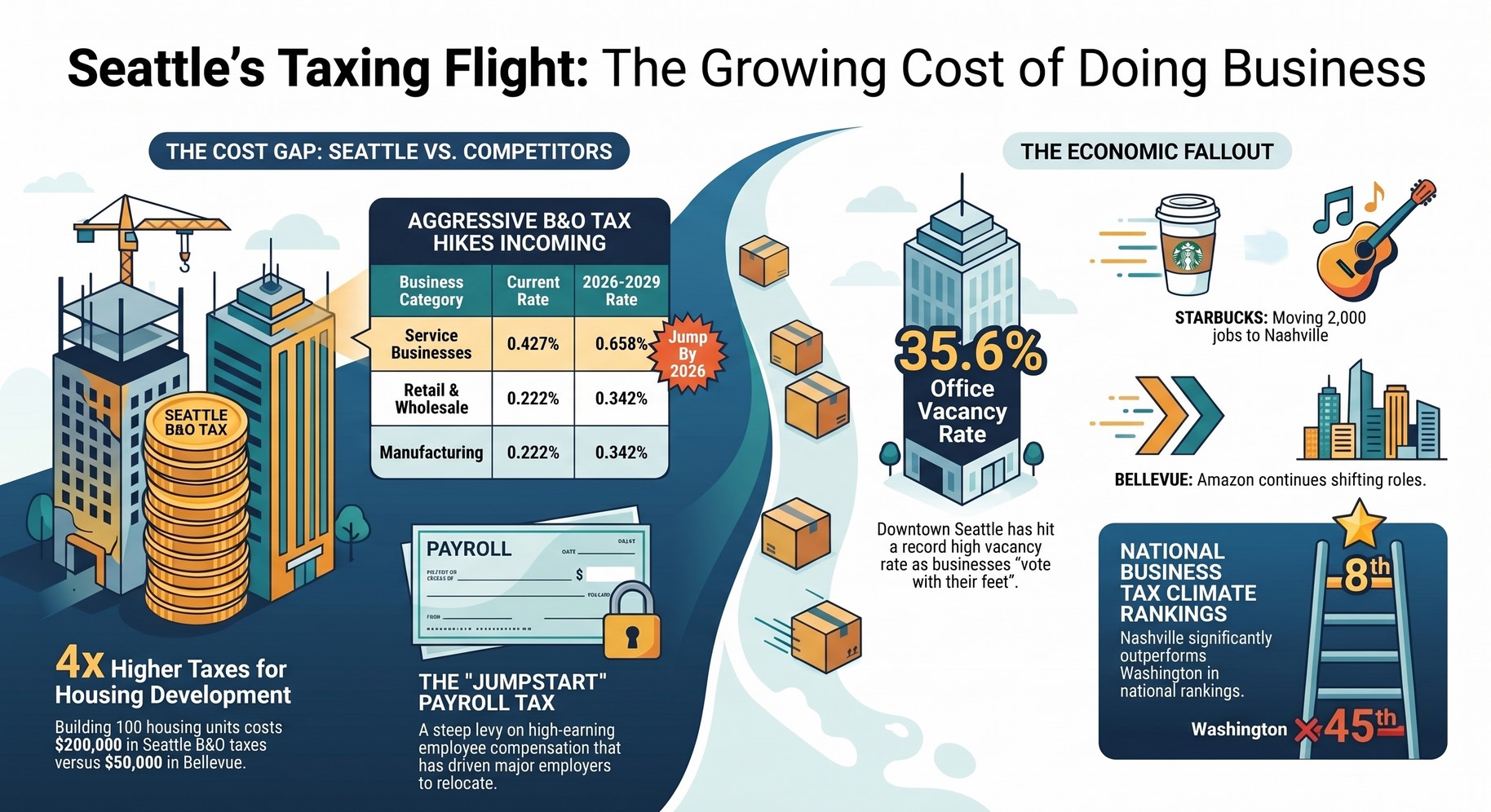




In a remarkably candid moment captured on Seattle Channel this week, Mayor Katie Wilson admitted what every local business owner already knows: it is simply less expensive to do business in Bellevue than in Seattle. The progressive mayor’s offhand concession, made during a budget discussion, should serve as a wake-up call for City Hall. Instead, Wilson doubled down, praising the very payroll tax that helped chase Amazon out of the city to Bellevue and floating a new local capital gains tax as a serious option.
Seattle’s JumpStart payroll tax hits large employers with a steep levy on compensation paid to high-earning employees. Wilson proudly noted it drove Amazon away yet somehow believes raising it further is a viable solution. On top of that, voters just approved sharp increases in the city’s Business & Occupation (B&O) tax. Starting January 1, 2026, the rate for service businesses jumps from 0.427% to 0.658% of gross receipts through 2029 (with an option to extend), while retail, wholesale, and manufacturing rates rise from 0.222% to 0.342%. Bellevue, by contrast, imposes a far lower, simpler flat B&O rate with no such bracket creep or sudden hikes. The result? A developer building 100 housing units in Seattle could face roughly $200,000 in B&O tax versus just $50,000 in Bellevue.
Wilson also declared a local capital gains tax “absolutely on the table.” Add in the state’s new 9.9% income tax and Seattle’s already high regulatory burden, and the math is brutal for any company trying to grow here.
The impacts are already visible. Starbucks, Seattle’s hometown icon, is pouring $100 million and 2,000 jobs into a new Southeast hub in Nashville, Tennessee, where the business tax climate ranks eighth-best in the nation versus Washington’s dismal 45th. The company has closed multiple Seattle stores and roasteries while shifting corporate functions. Amazon, stung by earlier payroll and head taxes, has steadily moved jobs across the lake to Bellevue. Downtown Seattle’s office vacancy rate has hit a record 35.6%, and the city is already losing hundreds of millions in tax revenue as employers vote with their feet.
This is not abstract economics. When businesses leave, so do jobs, investment, and the very tax base Wilson needs to fund her priorities. Yet instead of cutting spending or streamlining regulations, Wilsons administration’s instinct is to tax the remaining companies harder, creating a death spiral that punishes the very entrepreneurs who built Seattle’s economy.
Bellevue’s has acknowledged that Seattle’s tax policies are a gift to the city. It is time for Seattle’s leaders to stop celebrating business flight and start competing. Lower the B&O and payroll tax burdens, reject new capital-gains levies, and focus on making Seattle a place where companies want to stay and grow. Until then, Mayor Wilson’s own words will continue to ring out as the best advertisement Bellevue could ever hope for: “It is less expensive to do business in Bellevue than in Seattle.”