

Legislators have become aware of the poor condition of the state highway system, which has been deteriorating for years. This was highlighted by recent bridge closures, including the temporary closure of the SR 169 bridge over the Green River due to extensive corrosion, and the permanent closure of the SR 165 bridge due to structural deterioration. This week WSDOT announced the northbound lanes of the HWY 99 bridge over the Duwamish River would be closed for three days for emergency repairs. Those bridges are just the tip of the iceberg. WSDOT has identified more than two hundred bridges that are classified as being in “poor condition”, along with hundreds of miles of highway that are overdue for repaving. The WSDOT map below shows the extent of the problem.
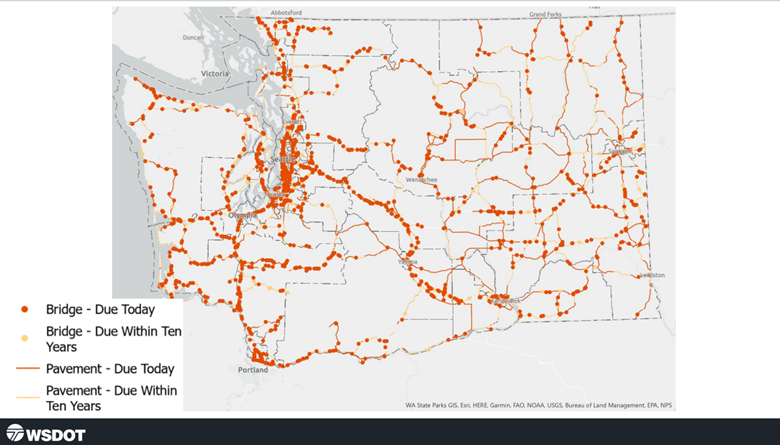
This shouldn’t come as a surprise. In 2023 WSDOT Secretary Roger Millar described the system as being “on a glide-path to failure”. In 2024 WSDOT estimated an additional billion dollars per year was needed to bring the highway system up to a state of good repair. Despite these ominous warnings, the transportation budgets submitted by the governor and passed by the legislature have not funded preservation and maintenance at anywhere near the level WSDOT has shown is needed. The result has been continued deterioration of the system and a growing backlog of paving and bridge repair work.
The usual explanation for this underfunding is that there just isn’t enough revenue to cover all the transportation projects the legislature wants. Since the list of things the legislature wants is unlimited this is undoubtably true, but that obscures the fact the legislature has an obligation to maintain and preserve state highway assets, and a constitutional requirement to use gas tax revenue exclusively for that purpose. That requirement, enshrined in the 18th amendment to the state constitution, says;
“SECTION 40 HIGHWAY FUNDS. All fees collected by the State of Washington as license fees for motor vehicles and all excise taxes collected by the State of Washington on the sale, distribution or use of motor vehicle fuel and all other state revenue intended to be used for highway purposes, shall be paid into the state treasury and placed in a special fund to be used exclusively for highway purposes.”
The 18th amendment came about because voters were fearful legislators would succumb to the temptation to divert gas tax revenue to other purposes, resulting in inadequate maintenance of state highways and bridges. In recent years that fear has been realized despite the constitutional protection.
The 2024 and 2025 transportation budgets ignored the constitutional requirement by diverting more than $200 million of gas tax revenue to bike, pedestrian and transit improvements that don’t qualify as highway purposes. This is described in an annual WSDOT report that lists bike, pedestrian and transit projects that have been funded with gas tax revenue. Those non-highway projects may be worthwhile, but they should be funded from other sources rather than diverting gas tax revenue from much needed highway maintenance and preservation.
The House and Senate transportation budget proposals now under consideration in Olympia increase WSDOT’s budget for preservation, but not by nearly enough to reduce the backlog. In fact, the underfunding is so severe the condition of the highway system is expected to further deteriorate. This will not only result in much higher costs when the needed repairs are eventually done, it will also subject motorists to years of road hazards and costs for car and tire repairs. There is also the very real possibility, perhaps inevitability, of more emergency road and bridge closures due to structural deterioration.
It is hard for the public to understand why this has been allowed to happen when Washington has one of the highest gas taxes in the country, as well as license and weight fees, and tolls on several highways in the Puget Sound region. What the public doesn’t see is diversion of gas tax revenue to non-highway uses or the $800 million per year in debt service the state pays out of the transportation budget on the billions of dollars in bonds that have been issued for WSDOT projects. To compound the budget problem, the legislature has spent more than four billion dollars to comply with a court order to fix culverts that block migrating fish. The culvert repairs were mandatory, but the legislature chose to fund that work from the transportation budget rather than using general fund revenue, exacerbating the transportation budget shortfall.
The public is very aware of the high price Washington residents pay at the gas pump, but they may not realize that about fifty cents per gallon is due to costs imposed by the Climate Commitment Act. That Act requires gas and diesel fuel providers to purchase carbon-emissions allowances from the state, the costs are then passed on to consumers. That generates hundreds of millions of dollars a year in revenue for the state, but when the legislature drafted the Climate Commitment Act they specifically prohibited the use of the carbon-emissions revenue for highway purposes. So, even though motorists end up paying at the pump, the funds aren’t used to maintain the highways and bridges they drive on.
The bottom line is that the legislature has made a series of decisions that have imposed new taxes and fees but a significant share of the revenue has been diverted to non-highway purposes.
The urgent need to maintain the state highway system has come up in the legislative session that is scheduled to conclude next week, but the importance of complying with the 18th amendment didn’t get a mention. Perhaps the 2027 legislature will finally face up to the need for highway preservation and ensure fuel tax revenues are used in accordance with the constitutional requirement. The road ahead is going to get increasingly bumpy until that happens.