


Electricity rates are rising rapidly in Washington state and there has been a significant amount of attention to the impact on residential customers.
There have been several stories about proposed rate increases in Western Washington. The proposal from Puget Sound Energy would increase electricity rates by 17% next year and by nearly 30% over the next three years. And while there has been a lot of focus on Puget Sound Energy, they aren’t the only ones increasing rates.
Seattle City Light increased rates 6 percent this year and they expect to increase rates by nearly 10% a year in both 2027 and 2028. In Spokane, Avista proposed increasing rates by about 14 percent next year and 25 percent by 2030.
So, what is going on? Why are rates increasing so rapidly across the state for both investor-owned and public utilities.
People have a lot of theories and the most popular one is that the rise of data centers and artificial intelligence is to blame for the increases. But data centers are having a small impact and aren’t what is behind the increases across the state.
Others point to profits for investor-owned utilities, but rates at public utilities are also increasing.
Like many things, the cause is more complicated, but at the center of much of the increase are state regulations that make it more difficult to provide reliable electricity.
The primary reasons relate to the state’s climate laws, the need to update utility lines to prevent wildfires and projected future demand. But before I address what is driving electricity rates, I want to look at how rates are set in Washington state.
Investor-owned utilities like Puget Sound Energy and Avista are regulated monopolies and their rates are set by the Washington State Utilities commissioners appointed by the governor.
When utilities need to increase rates, they submit cost information to the utilities commission and agency staff then go through the filings to verify the costs and see if the request is reasonable. The costs include maintaining the infrastructure like wires and other equipment, generating or purchasing electricity, as well as complying with regulations and safety including projects that reduce the risk of wildfire from transmission lines.
The amount paid by families is not just the cost of the electricity, but also a basic rate to cover the cost of maintaining the electrical system.
The public can be part of the rate-setting process, but some information is proprietary and is redacted from the filings. Instead, there is a public representative in the Attorney General’s office who has access to all the information and is supposed to represent ratepayers. In recent years, however, the public representative has actively worked against the public’s right to know.
In 2023, we revealed that the public representative in the Attorney General’s office encouraged utilities commissioners to hide the cost of the Climate Commitment Act – the state’s tax on CO2 emissions – from the public by keeping it off customer bills related to natural gas. We appealed that decision and, fortunately, utilities commissioners reversed that decision. Ratepayers can now see what the CCA costs them, but that was against the wishes of the public representative in the Attorney General’s office.
The public should not trust that the Attorney General’s office is looking out for them.
Rates must also reflect a reasonable profit for utilities. Like any other business, they deserve a profit but because they are monopolies, the reasonable amount is determined by utilities commissioners.
We want utilities to profit because when government caps returns at a needlessly low rate, it doesn’t allow utilities to deal with risk, like investing in reducing the risk of wildfire. Utilities must have the leeway to invest in things that may pay off only in the long run rather than looking for every nickel and dime to save on maintenance.
Although Public Utilities like Seattle City Light set their own rates, they also face similar choices. Recently, City Light came to an agreement to pay $1.5 billion for fish passage at dams on the Skagit River. While some point to profit as a cost driver, every utility faces challenges.
So, what is driving cost increases for both public and private utilities?
 With the growth in demand for data centers due to artificial intelligence, some suspect that is the cause of the increase. The data show that’s not the case.
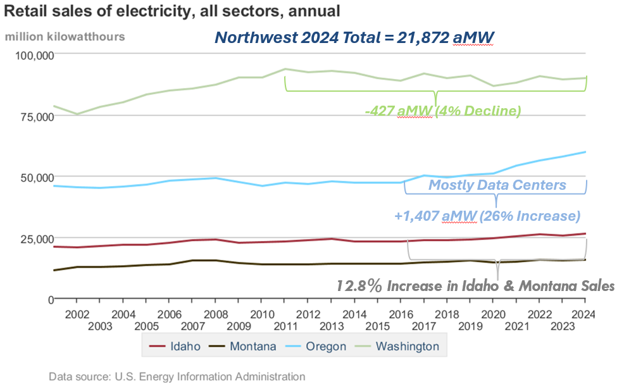
The amount of electricity required by Puget Sound Energy customers has been basically flat for the last decade. This is also true across the state. In 2024, retail electric sales in Washington were lower than in 2012.
Regionally, only Oregon has seen an increase in the past few years due to data center demand. This can have an effect on prices at the margin, but it isn’t the main driver of costs. In fact regional retail electric sales grew only 1.3% per year between 2016 and 2024. That’s growth, but not dramatic.
This is confirmed by Puget Sound Energy, who told me, “None of this growth is data-center driven.” Most of the current and projected growth in electricity demand is due to people switching to electric vehicles and some electrification of homes.
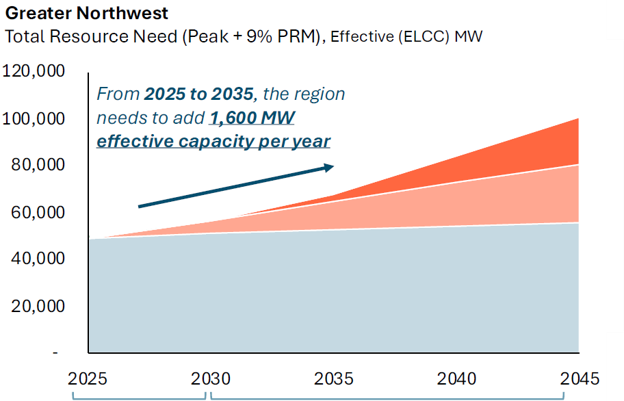 That doesn’t mean data centers won’t increase demand in the future. According to an analysis by utilities across the region, the Pacific NW must add 1,600 MW effective capacity per year for the next decade. That is like adding the equivalent of two Snake River dams a year for a decade. That increase isn’t due to data centers. It is the increase from projected population growth and electrification.
But even that isn’t what is behind the current cost increases for PSE, Avista, Seattle City Light and others.
What is driving it? To put it simply, Washington’s climate laws and the need to address risks like protecting the system from wildfires.
Utilities like Puget Sound Energy are upgrading their electrical systems to reduce the liability that would come with sparking wildfires. For example, PacifiCorp, which serves south-central Washington state, is currently litigating about $1 billion in damages due to fires plaintiffs claim the utility caused in 2020. Washington state law also requires utilities to plan for wildfire risk.
But the state’s law requiring utilities to meet wind and solar targets, known as the Clean Energy Transformation Act, or CETA, is playing a big role in driving cost increases. By 2030, the energy provided by utilities must be CO2 neutral and at least 80 percent of the generation must be from non-emitting sources of electricity, which includes hydro and nuclear.
As Rick Dunn, the CEO of the Benton County PUD noted, the increases are primarily result of utilities “scrambling to acquire scarce wind, solar and battery power to meet carbon-free mandates while keeping the grid reliable.” It is a difficult and costly balance and the bills are coming due with the state’s strict 2030 targets just around the corner.
The Northwest Power and Conservation Council echoes that assessment. In its “Power Supply Adequacy Assessment for 2029,” agency staff note that “significant increases in variable energy resources, such as solar and wind, have added a greater band of uncertainty in system operations,” which makes it more expensive to keep the system reliable.
So too do Washington’s utility commissioners. In approving rate increases earlier this year, “The commission recognized that a number of changes were real costs associated with statutory obligations, primarily the Clean Energy Transformation Act and the Climate Commitment Act,” according to a UTC representative.
Puget Sound Energy says about $4 billion of their $9 billion request is to comply with CETA’s renewable requirements.
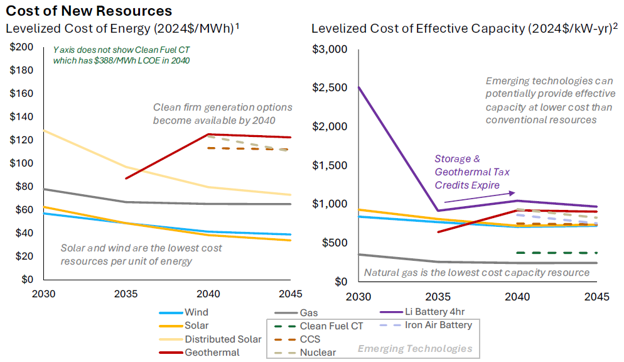 One claim made by Jay Inslee and other supporters of wind and solar is that they are the cheapest sources of electricity per kilowatt hour. A study by Energy and Environmental Economics released this year shows that is correct. Per unit of energy, wind and solar are about 25% less than natural gas on average. That, however, doesn’t tell the whole story and the requirement for wind and solar are driving costs up significantly.
Wind and solar are cheap when the wind is blowing and the sun is shining, but that doesn’t match when demand for electricity is highest.
At issue is what is called “effective capacity” which is how much generating capacity can be relied on to meet peak demand either in the evening, when electricity demand is highest, or during periods of high demand, such as very hot or very cold days.
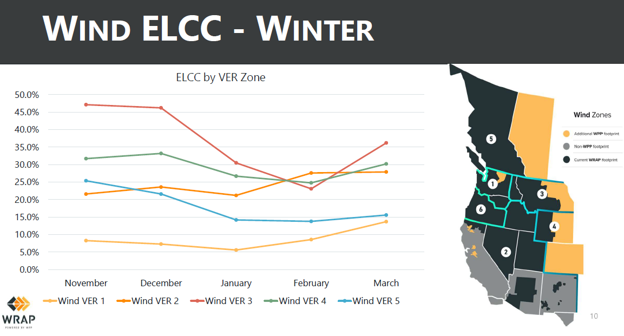
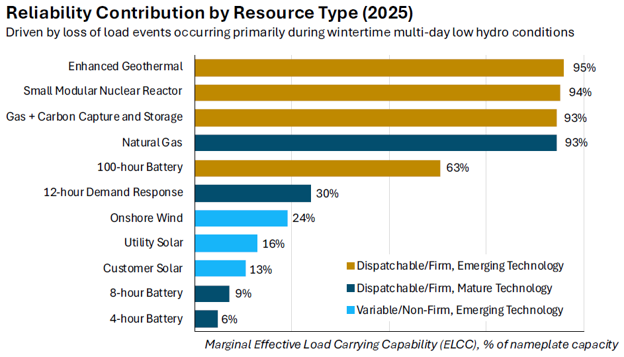 A study examining how much electricity will be needed to keep the lights on in the future found that in Winter – when Washington state’s demand for electricity is the highest – less than 10% of wind power could be relied on during those peak periods. The coldest days in Washington state are often very still, with virtually no wind across the entire Northwest. When electricity is needed most, wind disappears in Washington, Oregon and Idaho.
Utilities must build for the highest demand so even if solar is cheap when the sun is shining, it is incredibly expensive on short and cloudy winter days when temperatures plunge and electricity demand spikes.
As a result, the effective cost of wind and solar is much higher than natural gas. That same study from Energy and Environmental Economics shows that the effective cost of wind and solar is nearly four times as high as natural gas.
 Even if demand for electricity doesn’t grow in the aggregate, utilities have to replace natural gas – which is reliable when it is needed – with wind and solar, which must be overbuilt to keep the lights on for cold days in winter, and that increases costs for even the same amount of electricity.
So, before investor-owned utilities like Puget Sound Energy can supply data centers, they need to replace that natural gas with wind and solar, which requires them to build three times as much wind capacity as the existing natural gas and about four times as much solar.
And they have to do it fast to meet the first compliance period for CETA between 2030 and 2034. It is clear that some utilities are struggling to meet the deadline. That means higher costs. It also means the chances that we face energy shortages are increasing.
All of this means that even if Washington state utilities wanted to build large data centers, there isn’t much electricity to sell. Even if no new data centers are built, costs will continue to rise.
So, what can we do?
First, the legislature should recognize that their goals are unreasonable and are driving up costs.
Second, we need to give utilities options to build more reliable and low-cost electricity generation like natural gas. We helped author bipartisan legislation during the last session that would allow utilities to build natural gas if the risk of blackouts was too high. We will bring that legislation back again.
Finally, we need to shift control of electricity costs from behind closed doors and give it to the people. As we noted, we cannot rely on the public representative in the Attorney General’s office to represent the public.
Electricity prices should be transparent so people can use energy when it is cheap, such as at night and in the middle of the day, and avoid it when it is expensive, during the evening or on days with extreme weather. Fortunately, utilities are starting to introduce what is called time-of-use pricing, which helps consumers control their costs in a way they can’t now.
If you want to wash your clothes or keep your house at 72 degrees, you can do that, but you’ll be able to see the cost and judge for yourself rather than finding out the high cost in your bill at the end of the month. Research shows that time of use rates help people save money.
Electricity rates will continue to increase in Washington state and the only way to slow that increase is to focus on the real cost drivers, like state laws and regulations. Blaming data centers and profit are a useful way for politicians to distract from their own culpability but won’t reduce the pain being felt by families across the state.