




Do people care more about environmental stewardship or using the environment as a political bludgeon against their enemies? Judging by the discourse in Washington state many progressives believe the political value of environmental rhetoric supersedes the value of delivering environmental results. On the right, too many treat every environmental concern as a Trojan Horse for socialist policies, sometimes refusing to acknowledge even legitimate ecological risks.
That divisiveness has made productive environmental efforts extremely difficult and puts the most partisan voices in charge of environmental decision-making. That must change. Fortunately, the majority of people in the state are very practical about environmental issues – wanting to care for the planet in a way that is effective and affordable. Bill Gates’ letter on climate policy is a reflection of that thoughtful and productive mindset.
Finding a positive approach to environmental stewardship isn’t easy. My writing on environmental solutions receives far fewer likes and shares on social media than my critiques of wasteful government policy. People connect more to government corruption than environmental care.
To be sure, working on environmental policy sometimes feels very upper-middle class. Many of the people who dominate environmental discussions can easily afford to pay the price of the aggressive and costly environmental policies they promote. They feel righteous about saving the planet as others struggle to deal with the impact of regulations regarding the latest environmental concern.
Some activists realize this, so they exaggerate the environmental benefits, claiming that the planet will die without their work. It is not enough that climate change creates risks to people and the environment – it must be an “existential crisis.”
This exaggeration isn’t limited to climate change.
As a beekeeper, people occasionally come up to me and thank me for saving the bees, because, they say, without bees there would be no food. When I tell them that isn’t really the case, they look surprised. When I add that honeybees are actually an invasive species in most of the world and may harm native bees and other insects, that look turns to one of real disappointment, as if I have taken something from them.
Environmental activists hope exaggerations will magnify the value of their commitment (and self-worth) and undermine claims that they are callously harming others with environmental taxes and regulation while they live comfortably. But repeated exaggerations end up being counterproductive. You can only scream that the world is coming to an end so many times before people start to think environmental concerns are phony when the world doesn’t end.
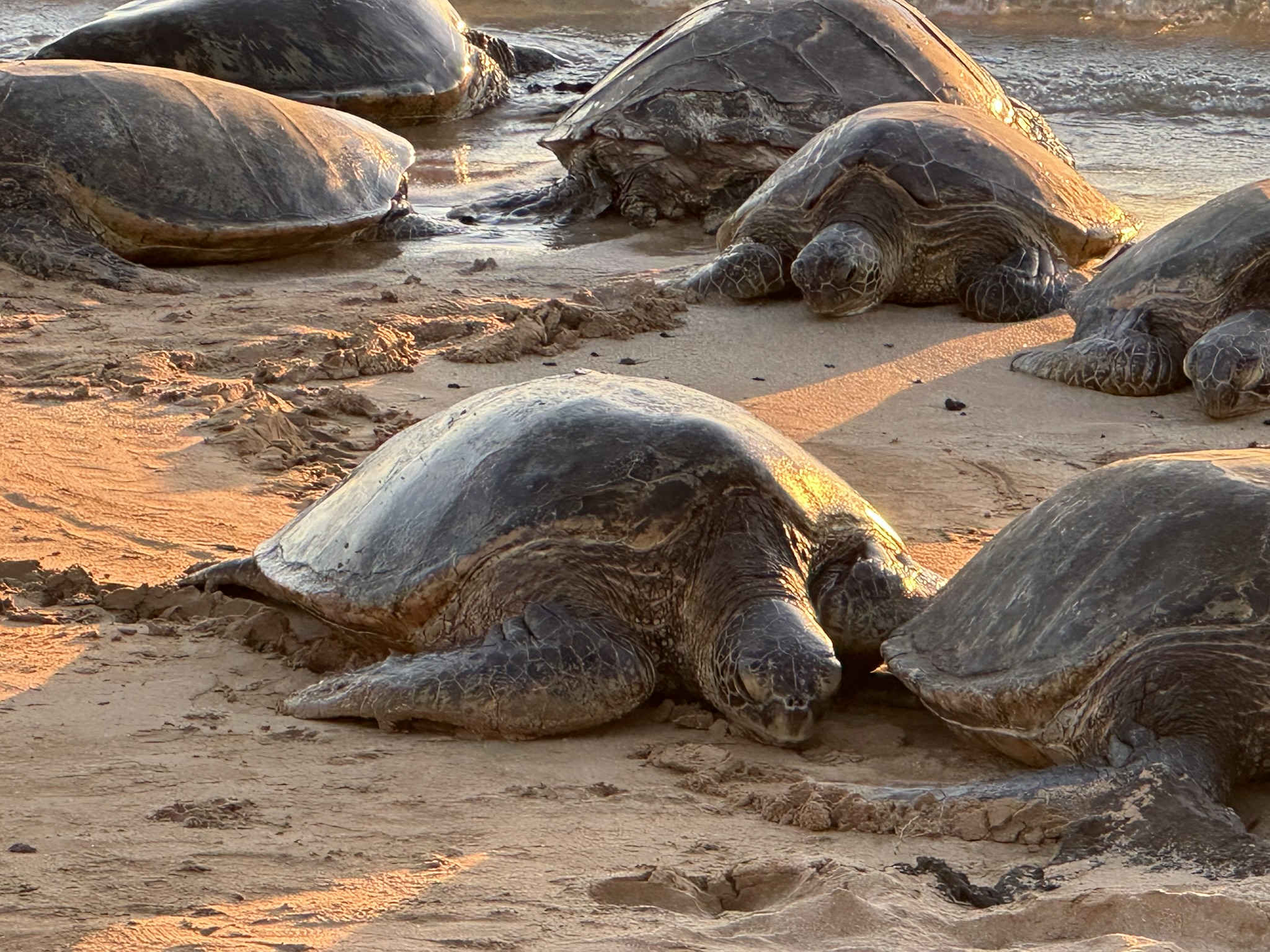 There are also moments like I had this week, where I stood on a beach in Hawaii and watched as threatened Hawaiian Green Sea Turtles – known as “honu” in Hawaiian – crawled up on the beach to rest for the night. They are truly beautiful creatures and the thought that human carelessness and trash (like abandoned fishing nets) would lead to them being harmed bothers me. I truly appreciate the work of the volunteers on the beach who worked to keep people from getting too close to the turtles as they rested.
I thought of the work of Paso Pacifico, a group I wrote about in my last book, that works in some very tough environments in Central America to prevent the poaching of sea turtle eggs. I was supposed to go to Nicaragua to see their work first-hand but had to cancel because the political situation had become violent and it wasn’t safe. They courageously continued to do as much work as they could.
Their situation is truly a clash of the poor poachers who sell the eggs so they have money to live and wealthy donors who want to preserve sea turtle populations. Paso Pacifico breaks that deadlock by working with poachers to show them which turtles are most threatened so poachers can take eggs from turtles with larger populations.
If the work WPC does empowers Paso Pacifico and the many others who make environmental stewardship their work in Central America or Washington state or elsewhere, then it is truly worthwhile.
At the other end of the political spectrum from those who exaggerate the risks to the planet are those who dismiss concerns as a “hoax.” They minimize threats to wildlife and the environment, seeing the current environmental movement as a cover for other ideological agendas.
I have sympathy for this view. When people see government-run environmental programs fail again and again, it is natural to conclude that politicians don’t care as much as they say. And when money that is supposed to be used to address the “climate crisis” ends up in the pockets of political allies, it validates the claim that government spending on environmental programs has become a grift. In many cases, it has.
Despite that, there are real and important environmental problems that we have a moral and practical obligation to address. Salmon populations, and Southern Resident orca with them, aren’t recovering as I would like, and their populations are too low. Native insects, like bumblebees, are struggling and we don’t know the implications of their decline. Forests are still recovering – and will be for another century at least – from our lack of understanding of fire ecology during the last century. Outside of Washington state, we need to reduce the amount of plastic entering the ocean.
I have spoken to many conservative groups, and every time people express a desire to be good environmental stewards, but they worry about being duped into supporting wasteful and corrupt government programs. They want to know what issues are real and which ones are Trojan Horses for an ideological agenda. Others simply say they appreciate what I do but are far more interested in other issues. I understand that not everyone has the same priorities as I do.
If my record of myth-busting and attempting to hold bureaucracies and politicians accountable for failure makes me more credible when I point out what I think are real environmental concerns, especially for those who might not otherwise pay attention, then WPC’s work on these issues is worthwhile. And if I can offer policy solutions that are amenable to people who have a negative and visceral reaction to the typical bureaucratic approach, even better.
That is the role WPC plays regarding environmental challenges and it is the one we will play in 2026 – environmental mythbuster where problems are exaggerated and government programs are more about politics than results, and environmental advocate where there are real and important environmental challenges to which we have an ethical or practical responsibility.
The good news is that when we do environmentalism right – engaging the public, property owners and innovators instead of treating them as the enemy – it works.
The sea turtles on the beach in Hawaii are a good example. The population of Hawaiian Green Sea Turtle is growing, thanks in part to members of the public who work to protect them on the beach. At another beach on Kauaii, I ran into volunteers with the Surfrider Foundation who were retrieving an abandoned fishing net that could ensnare turtles and other marine animals.
Government policy will continue to have a role to play, but the heavy handed, 1970s approach doesn’t work well and is creating disillusionment. The first step in reforming environmental policy has to be ending bad policies that waste money, politicize environmental stewardship and create resentment toward environmental efforts in general. In 2026, we will (again) highlight many of the state’s failed and, occasionally, corrupt policies.
But we will also continue to be aggressive to offer alternatives that promote personal engagement, innovative conservation technology, effective government engagement and efforts that are based on real-world results.
If we are successful, we will be able to help sea turtles and many other species long into the future.