


I love Ken Jennings. I caught up with his original million-dollar-plus run on Jeopardy via streaming last year. His story makes him the perfect successor to the late, great Alex Trebek and miraculously, the TV gods allowed him to take the mantle of the long-running game show despite not being a celebrity or being named Seacrest (another wonderful surprise to me on Wheel of Fortune).
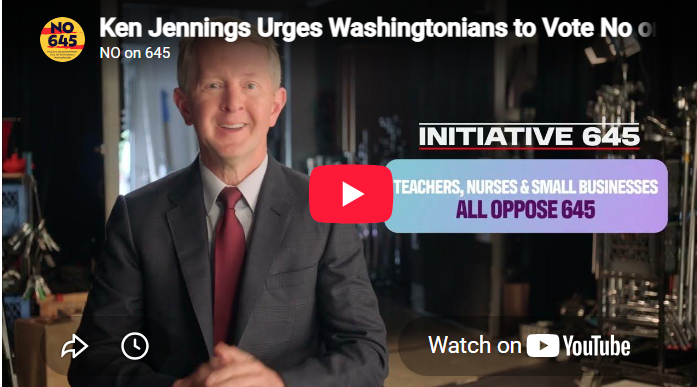
But in his latest video "Ken Jennings Urges Washingtonians to Vote No on I-645" shows he may be a trivia master, but Washington state policy is not his strongest category. Let's take a look at his policy claims one by one for a fact check.
Here's Ken's video. Corrections follow.
Jennings Claim #1: "Initiative 645 would give millionaires and billionaires a $13 billion tax break"
Answer: The tax has not been collected yet. Since when is it a "tax break" when people say no to hiking taxes? Furthermore, there are tradeoffs. The latest study from The Buckeye Institute and Washington Policy Center estimates the new income tax tax could reduce new employer businesses by 11.9%, which is about 1,400 fewer new businesses and about 6,100 fewer jobs each year. So while the state gains revenue (which it was doing prior to passing an income tax), the rest of the economy suffers.
The WA State Commerce Department (under Democratic governors) cited our income-tax free status as a major attractant to new businesses and investment in Washington. WA experienced tremendous revenue growth during that period that benefited everyone.
The question isn't "Should we give millionaires and billionaires a $13 billion tax break?", but "Should we implement a new income tax that lays the groundwork for future expansion to all?"
Jennings Claim #2: Repealing the income tax would make "Washington’s unfair tax system, where working families pay three times more than the wealthiest, even worse."
For years, pleas to ease the burden on lower and middle income Washingtonians have been part of the battle cry for higher taxes. Yet despite many years and billions of dollars in more-than-expected revenue, legislators cut the state sales tax rate exactly zero times -- since 1982. Think of it like calling for a hose to relieve the thirsty, then distributing water to the thirsty with a syringe and keeping the hose for yourself.
Furthermore, while Washington is regularly condemned as a highly regressive state, the states heralded as "more progressive" in tax policy than Washington also have a higher overall tax bill for working families. Lower regressivity also did not mean a lower tax bill. Using the Tax Foundation’s 2022 resident-burden estimates, the 10 least-regressive states averaged 12.45% of income, compared with 9.68% for the most-regressive states. That is 29% higher. Average burden per resident was $8,302 versus $5,790, a 43% difference.
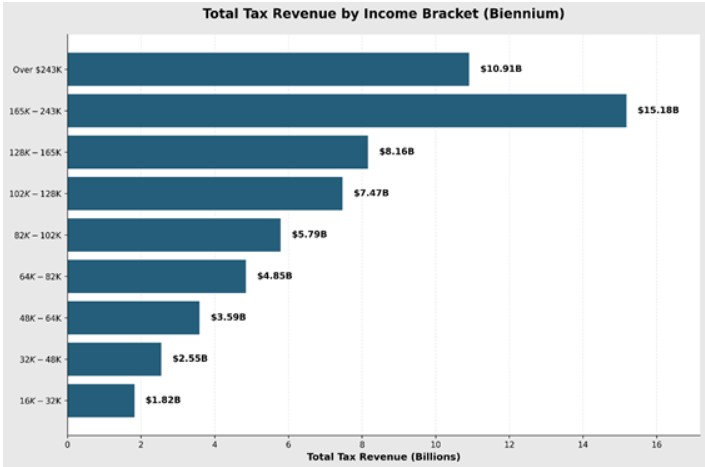
Low-income families do pay a higher share of their income in taxes but when you look at total dollars collected, higher earners contribute the overwhelming majority of tax revenue, contributing tens of thousands of dollars more per year than anyone else.
Lower income earners shouldn't be taxed so much, but it doesn't follow that we should hurt our economy and create an income tax.
Jennings claim #3: Eliminating the state's income tax would mean huge cuts to public schools.
The income tax pays $0 dollars for public schools now, so if voters were to eliminate it, it would cut $0 dollars from our K-12 system. It's possible Mr. Jennings read the biased and misleading "Public Investment Impact Disclosure" statement for this one. In the past dozen years, Between 2012 and 2024, Washington’s education spending increased significantly, jumping from $13,775 to $19,163 per student, a 39% increase, adjusted for inflation. Washington has been dramatically increasing funds for education without an income tax.
Jennings claim #4 "teachers, nurses, and small businesses all oppose 645 [the repeal of the income tax]."
This is assuredly true but also irrelevant. Undoubtedly, there are "teachers, nurses, and small businesses" that support I-645. What is meaningful is that voters in Washington have said "no" to income taxes ten times at the ballot box and the legislature went out of its way to make it more difficult for voters to have their say on this one. It should also be noted that income is considered property in Washington state (property defined as "anything tangible or intangible subject to ownership") -- as property, our constitution prohibits graduated taxes on it. Current advocates are trying to twist the plain language and convince the court that income isn't property.
Double Income Tax Jeopardy: Where the scores really change. Now some answers in the form of questions for Ken Jennings to consider:
1. If this is merely an income tax aimed at the very rich, why were multiple efforts to limit the tax to millionaires voted down at the time of its passing?
2. If this is a tax aimed at the rich forever, why did it change pension law so that pensions could be captured as income?
3. If this income tax is a tax on millionaires and billionaires, why are legislators already talking about reducing the threshold to $250,000?
4. What do you think the consequence will be for Washington of the exodus of opportunity happening where people who pay far more in total tax dollars and create jobs are leaving the state because it has become less competitive? With Washington's business tax ranking collapsing between 2014 and 2025, and our state going from the 6th best for business to 45th, how does adding an income tax make Washington a better place for businesses to locate, expand, and create jobs?
5. How will Washington education funding be impacted if it becomes reliant on Income taxes, which are notoriously volatile sources of revenue?
Even after years of surplus revenue amounting to billions of extra dollars, the biggest tax increase in state history, another tax increase, new payroll taxes, a new capital gains tax, and a new income tax, Washington faces a looming $7 to $10 billion dollar deficit. Washington's problem isn't that it doesn't have an income tax, it's that it doesn't have spending restraint. So final question, Shouldn't a quiz show host as good and smart as Ken Jennings know these things?
Income taxes put Washington's future competitiveness in Jeopardy. And it's no game.