
- An objective comparison between what officials promised and what was provided shows the levy failed to deliver the road maintenance and improvements officials promised.
- Instead of reducing the maintenance backlog by half over nine years, recent estimates show road and bridge maintenance needs have ballooned to nearly $2 billion. The arterial pavement backlog alone has tripled to $970 million.
- Seattle officials say they have paved 225 lane miles of arterial streets and plan to pave 11.5 miles this year, falling 34 percent below their 2006 promise.
- As early as 2011, Seattle officials admitted, “Bridging the Gap was never supposed to fill the gap.” Many streets, “once decorated with ‘Fix This Street’ signs, are still not fixed,” according to Seattle Post Intelligencer columnist Joel Connelly.
- By 2015, general fund spending on other government programs increased by 38 percent over 2006 service levels, but general fund appropriations to transportation services increased less than one percent.
- Some of the biggest transportation problems in Seattle, like traffic congestion and the growing road maintenance backlog, are worse today than before the Bridging the Gap tax program started.
- Mayor Ed Murray and city leaders say they want a new 9-year, $935 million property tax levy to increase transportation spending. The new property tax would be more than double the tax burden of the expiring levy it would replace.
Introduction
The Seattle Department of Transportation is responsible for maintenance and preservation of the city’s bridges, streets, arterials, sidewalks, and bike paths. In 2006, city officials said they wanted a property tax increase of $365 million, one of the largest in city history, over nine years to reduce the city’s street maintenance backlog, boost transit service, and expand bike paths. That November, 53 percent of voters approved, and citizens began paying the requested funds to city officials.
The Voter’s Guide explained how city officials promised to use the new revenues if residents agreed to the requested tax increase:
“If approved, this proposition would fund facilities and services, including: street and bridge maintenance; enhanced transit services; bicycle, pedestrian and safety programs; and a neighborhood street fund, under Ordinance 122232. It would authorize regular property taxes higher than RCW 84.55 limits, allowing collection of up to $36,650,000 in additional taxes in 2007 and up to $365,000,000 over nine years. The 2007 total regular tax limit would be $3.69/$1,000 assessed value, including approximately $0.36 additional taxes. Should this levy lid lift be approved?”
The Bridging the Gap plan, which ends this year, is projected to receive all of the originally estimated $365 million in tax revenue from Seattle citizens. Seattle officials claim the Bridging the Gap tax funded a successful program, yet an objective comparison between what officials promised and what was provided shows the levy failed to deliver the road maintenance and improvements officials promised when they began collecting the additional property tax revenue. Mayor Murray and city leaders say they want a new 9-year, $935 million property tax levy to increase transportation spending. The new property tax would be more than double the tax burden of the expiring levy it would replace.
As Seattle officials ask voters to approve a new and larger Bridging the Gap levy, this paper reviews the performance of the last such special levy, reports on Seattle’s growing road maintenance backlog, compares city officials’ past promises and discusses the city’s overreliance on local levy dollars to fund core public services.
Bridging the Gap property tax levy (2006-2015)
In 2006, Seattle City Councilmembers sent the Bridging the Gap tax program to the November ballot. The council’s first proposal, a 20-year, $1.1 billion property tax increase, met fierce public opposition and was dubbed a “never-ending tax” by many citizens.
Two months before the election, councilmembers pulled back on their 20-year plan, and opted instead for a 9-year, $365 million property tax increase. Although sharply scaled back, the Bridging the Gap program was still the largest property tax levy in Seattle history.
Coupled with a new commercial parking tax and business taxes, Seattle officials said they would use revenue from the historic tax increase to:
- Cut the street maintenance backlog in half;
- Triple public spending on arterial maintenance by paving 360 lane miles of arterials;
- Fund 45,000 added hours of transit service;
- Increase pedestrian and bike safety;
- Repair the city’s bridges;
- Prune trees, repair sidewalks, fix pedestrian stairways.
Overall, officials said they would use the new funding to reduce their maintenance backlog and modernize and update Seattle’s streets, sidewalks and bridges. Campaign yard signs promising to “Fix This Street” appeared throughout the city to urge residents to vote “yes” on the new levy.
Did officials reduce the maintenance backlog and meet promises?
In 2006, city officials said their road maintenance backlog had swelled to almost $600 million. The arterial pavement backlog represented about half of the needed work, at $300 million.
But instead of reducing the maintenance backlog by half over nine years, however, recent estimates show road and bridge maintenance needs have ballooned to nearly $2 billion. The arterial pavement backlog alone has tripled to $970 million.
As early as 2011, Seattle officials began to prepare the public for falling short, saying “Bridging the Gap was never supposed to fill the gap.” Seattle Post Intelligencer columnist Joel Connelly determined many arterial streets, “once decorated with ‘Fix This Street’ signs, are still not fixed.” He pointed to the lack of road maintenance on Union Street and Boston Street as prime examples of city officials’ failures to follow through on their promises.
Connelly’s reporting is accurate. Shortly after voters agreed to pay the requested Bridging the Gap taxes, Seattle officials began to scale back their promises. In all, Seattle officials fell short on their pavement promises by 34 percent since voters approved the requested tax increases:
- Two months before the vote, Seattle officials said Bridging the Gap taxes would fund 360 lane miles of arterial paving over nine years.
- Four months after the vote, Seattle officials said Bridging the Gap taxes would fund 300 lane miles of arterial paving over nine years, a 16 percent cut from their original promise.
- Today, Seattle officials said they have paved 225 lane miles of arterial streets and plan to pave 11.5 miles this year, beating their new goal of 200, falling 34 percent below their 2006 promise.
In 2006 Seattle officials said, in addition to street improvements, four major capital improvements would progress under the Bridging the Gap tax program, including: Spokane Street Viaduct, Lander Street overpass, Mercer Street Corridor, and King Street Station. According to reporting by KING 5 News, officials “effectively killed” the Lander Street overpass project, choosing to divert tax money to cover rising costs at the Mercer Street project instead.
Overreliance on special levies to fund basic maintenance
In 2006, Mike Lindblom of The Seattle Times summed up the spending program as “a general increase in the transportation budget,” which was missing the “very detailed commitments” found in other Seattle levies. In fact, officials used special Bridging the Gap levy dollars for routine maintenance, instead of boosting general fund appropriations over the life of the tax increase.
In 2006, Seattle’s total general fund budget reached $768 million, of which $40 million was appropriated to the Department of Transportation. By 2015, while general fund spending surpassed $1 billion, the city’s appropriations to transportation services remained at around $40 million. That means that by 2015 city officials had increased general fund spending on other government programs by 38 percent over 2006 service levels, but their appropriations to transportation services had increased by less than one percent.
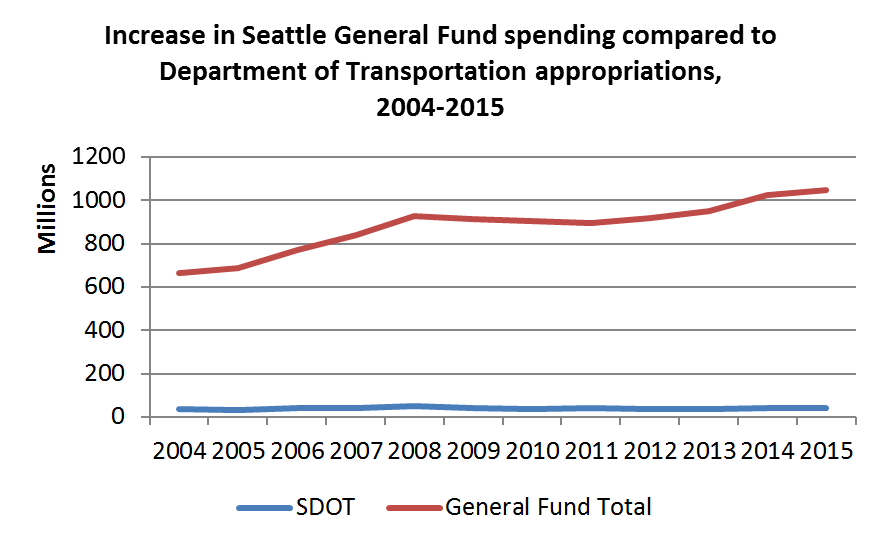
Source: 2004 – 2015 City of Seattle Adopted Budgets. The funding disparity and the lack of general fund resources city officials provide to support arterials and neighborhood streets is shown.
Despite the lack of general fund support, officials have increased the Department of Transportation’s budget over 170% since 2006 by increasing the local levy tax burden on households. However, officials chose not to substantially expand the road network, and opted instead to increase bike trails and paths around the city.
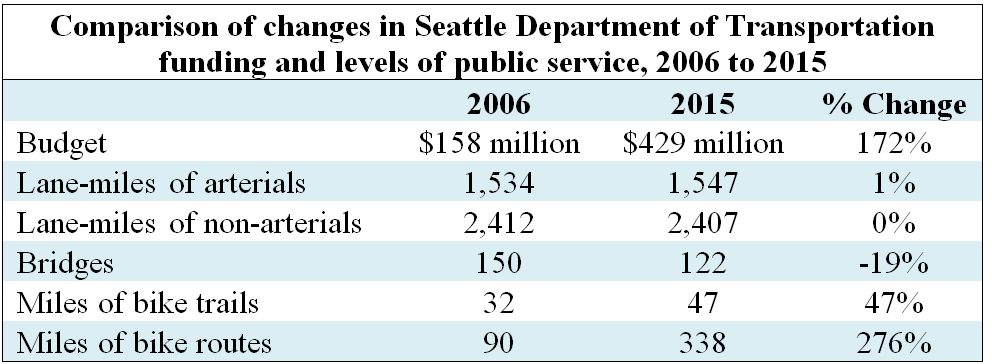
Source: 2006 and 2015 City of Seattle Adopted Budgets.
The disparity in funding priorities and the apparent discrimination against drivers contributes to the public’s perception that officials are conducting an unannounced “war on cars” against people seeking to use public roads in Seattle.
Conclusion
Despite the claim by Seattle officials that their $365 million in spending under the Bridging the Gap program was a success, an independent review shows that over nine years the level of public service provided falls well short of what officials promised when they asked voters for this large property tax increase in 2006.
Some of the biggest transportation problems in Seattle, like traffic congestion and the growing road maintenance backlog, are worse today than before the Bridging the Gap tax program started. City officials have not cut their maintenance backlog in half, as promised, and the lack of new lane-miles provided and reduced street capacity has lowered the ability of people to move around the city.
Mayor Murray and other city officials now want to raise the property tax burden by nearly $1 billion for a second, and more costly, Bridging the Gap program. The poor performance of the past levy raises questions about how officials plan to use any new property taxes, should voters approve. The past management of these levy funds indicates that, even at record levels of spending, the money from the new levy would not be used effectively enough to reduce the street maintenance backlog or reduce traffic congestion for people living in Seattle.