



Washington state's operating budget has doubled over the past 10 years, climbing from roughly $38 billion to $80 billion. A handful of progressive advocacy groups are nevertheless telling the public that the budget has been shrinking.
That claim is not supported by any number in the actual budget, by per-resident spending, by per-resident revenue, or by any other standard measure. But according to a set of carefully constructed ratios, all of which conveniently point toward the same goal of even higher government spending, we’re supposed to believe the state has somehow been impoverishing itself for two decades.
The latest claim came in response to former Gov. Chris Gregoire's comments at the Association of Washington Business Spring Summit on May 6, where she correctly pointed out that the state's operating budget went from about $30 billion when she left office in 2012 to about $80 billion today.
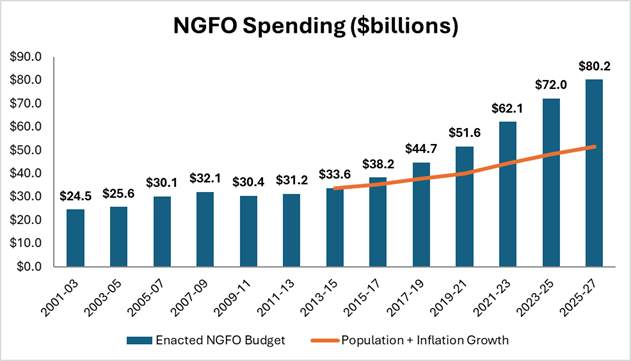
The chart below shows what she was describing. The Near General Fund (Outlook) state operating budget grew from $31.2 billion in the 2011-13 biennium to $80.2 billion in the 2025-27 biennium, a 157% increase in nominal dollars.
If NGFO spending had grown only with population and inflation since 2013-15, this biennium’s budget would’ve been $51.6 billion (using the state’s own population and inflation data.) Instead, it is $80.2 billion, 55% above the population-plus-inflation benchmark.

Source: Washington State Fiscal Information
The Northwest Progressive Institute (NPI) responded to Gov. Gregoire’s comments with a blog post calling her comparison "irresponsible" and arguing the state budget has actually been shrinking. NPI never disputes the $33 billion to $80 billion figure, because it can’t, so instead they argue that absolute dollar comparisons are illegitimate and that "in relative terms — the only terms worth using for comparisons — the state budget has gotten smaller." Why are the “relative terms” the only terms worth using? The NPI study never says.
The Economic Opportunity Institute (EOI) published their own study in February claiming the budget has "declined by 60% overall."
The Washington State Budget & Policy Center contributed a chart titled "Communities were more well-funded by the state budget 30 years ago than today."
At first glance, three different studies reaching the same conclusion looks like convergent evidence. It is not. All three rest on the same unstated assumption: that Washington's state government has an obligation to grow at the rate of the private economy, and that any time the economy outpaces government spending, the gap should be counted as a cut. Strip out that single shared premise and all three arguments collapse together.
It is worth noting that their assumption only works in one direction. None of these groups argued during the Great Recession or COVID that government should shrink to match the slumping private economy. They argued then for more spending to offset weak growth, just as they argue now for more spending to capture strong growth. Whether the economy is booming or contracting, the answer is the same.
Contrary to the claim that spending shrank, official OFM data show that real per-capita state and local revenue rose from $7,714 per Washington resident in 2005 to $11,376 in 2023, a 42% increase adjusted for inflation, with Washington ranking 11th highest in the country on this measure in 2023.
Real per-capita state and local taxes have climbed at a similar pace, with Washington ranking 14th highest in the country in the same year. Adjusted for inflation, Washington’s state and local governments take more from each resident than they ever have.

Source: Office of Financial Management
Keep in mind, these OFM figures only run through fiscal year 2023, and the Census data that feeds the per-capita series carries a multi-year lag. They do not yet capture roughly $9 billion in tax increases passed by the Legislature in 2025, another $2 billion tax package approved during the 2026 supplemental session, a new income tax that takes effect in 2028, or the nation's first-ever raid on a public pension fund. Once those packages flow through, the per-resident tax and revenue figures will be considerably higher than what is published today.
Let’s look at how each group manipulates the data.
NPI's argument cites OFM's figure for state and local expenditures per $1,000 in personal income, which fell from $189.98 in 2005 to $170.25 in 2023, and concludes "that's shrinkage." It is not shrinkage. It is a ratio that fell because Washington's private economy and wages grew faster than government spending. The author leaves out the inconvenient detail that the per-capita revenue and per-capita tax columns on the same OFM page he cites, shown in the chart above, rose substantially over the same period.
EOI's calculation is even more aggressive. It compares the operating budget to total personal income, then divides again by population. But total personal income already scales with population. The second division pulls the same factor out twice, leaving a ratio that can shrink while real spending per resident climbs, as it is today. This number is meaningless.
The flaw is easiest to see by holding the per-resident numbers constant. Imagine Washington's population doubled while per-person income and per-person spending held perfectly steady. Total personal income would double, because there would be twice as many earners contributing identical amounts. The total operating budget would also double, because the same per-person spending would now reach twice as many people. By EOI's formula, however, the operating budget would apparently shrink by 50%.

Source: Economic Opportunity Institute
EOI itself concedes in the same piece that the inflation-adjusted operating budget grew from $22 billion to $37 billion, a 68% real increase, before complaining that the budget "didn't keep up with our state's capacity to invest." In other words, lawmakers could have squeezed more out of the growing economy but chose not to.
The Washington State Budget & Policy Center's chart is similarly flawed. It displays two bars: the 1995-1997 operating budget at $73.2 billion and the 2023-2025 budget at $69.8 billion. The fine print at the bottom reads "adjusted for economic growth." The actual 1995-1997 Near General Fund operating budget was about $19 billion. The Budget & Policy Center took that real number, scaled it up to $73.2 billion by assuming the budget should have grown for nearly 30 years at the rate of total personal income growth, and then placed the imaginary figure next to today's actual budget.

Source: Washington State Budget and Policy Center
The same flaw runs through all three studies. They treat state spending as inadequate unless government grows in lockstep with the private economy. If personal income rises faster than the budget, they call that a cut, even when state spending is higher than ever in total dollars, per person, and after adjusting for inflation. They make no effort to determine if more government spending is necessary or would be beneficial. They don’t explain why the ratio of government spending to personal income in 1995-97 was optimal. They just assume that it is unfair for people to prosper more than government.
In fact, Washington’s tax structure already captures economic growth. The state collects revenue primarily through the sales tax, the business and occupation (B&O) tax on gross receipts, the real estate excise tax, and property taxes. Each of these taxes grow automatically as the economy grows. When workers in the tech sector earn more and spend more, the state takes its cut at the register. When Microsoft books more gross receipts, the B&O claims its share. When home prices rise, property and excise collections rise with them. Olympia does not have to pass a single new tax to claim a piece of Washington's economic growth, as the existing structure has done so consistently for decades. That is why Washington has had the best revenue stability of any state over the past five years.
State budgets are sized to deliver specific services to a specific population, and they grow when those services become more expensive or when more residents need them. They do not need to grow simply because incomes in Bellevue and Redmond went up. When Washingtonians work harder, build companies, get promoted, or sell homes for a profit, the resulting income belongs to the people who earned it. It does not create a proportional obligation to Olympia. Each of these studies treats private wealth creation as a trigger for additional public claims on that wealth, which is a redistributive policy preference, not a requirement for state government to operate.
These studies are not “the truth about Washington state’s finances,” as NPI claims. They use a selective benchmark to support their predetermined conclusion that Olympia should be spending more.
Here's the actual truth: the state operating budget and real per-resident revenue and taxes are all at the highest levels in Washington's history, and the 2025 and 2026 tax packages will push them higher still. Olympia clearly does not have a revenue problem. The legislators and advocacy groups driving these historic tax hikes cannot defend the spending, so they are rewriting the math instead.