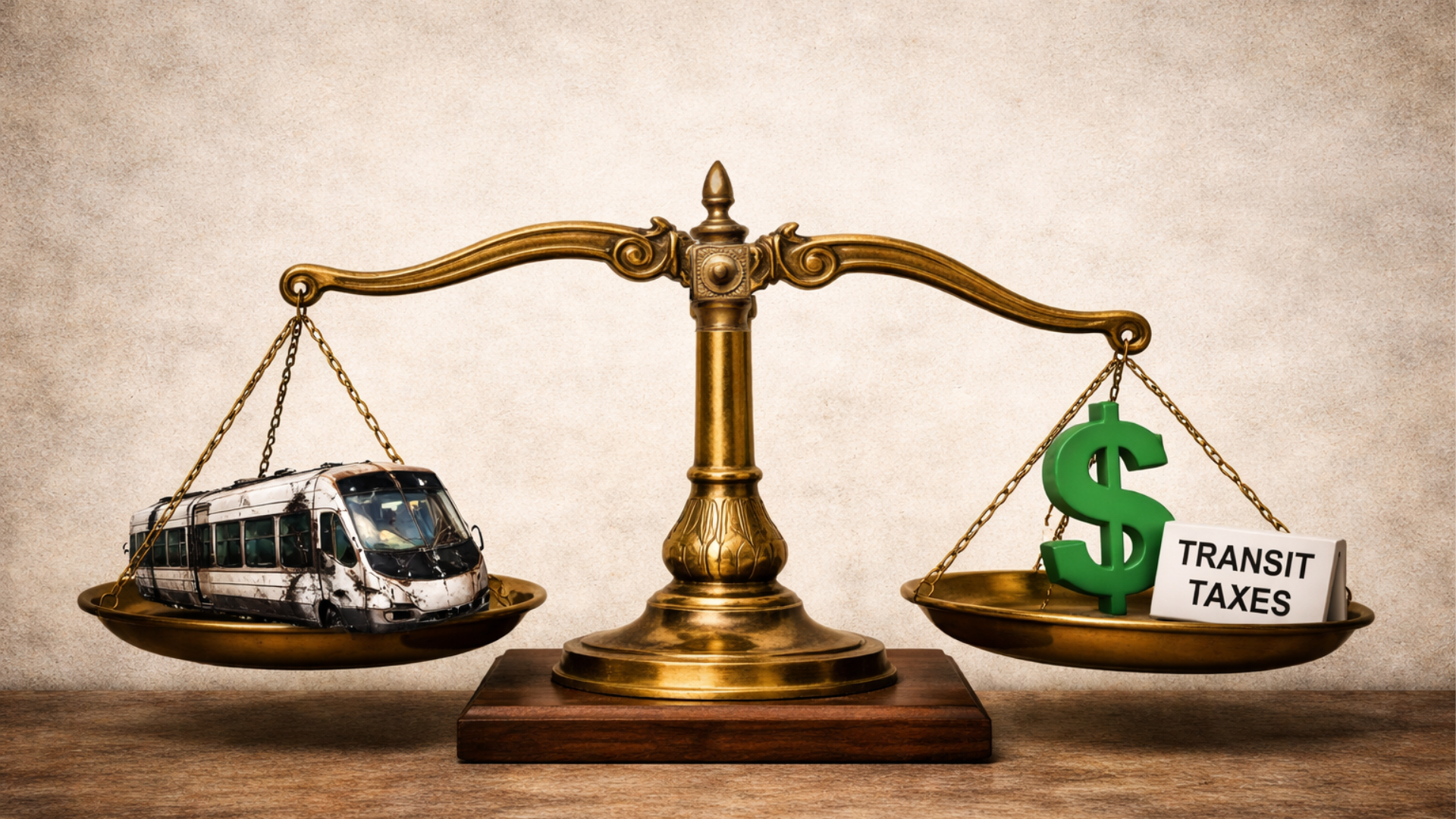

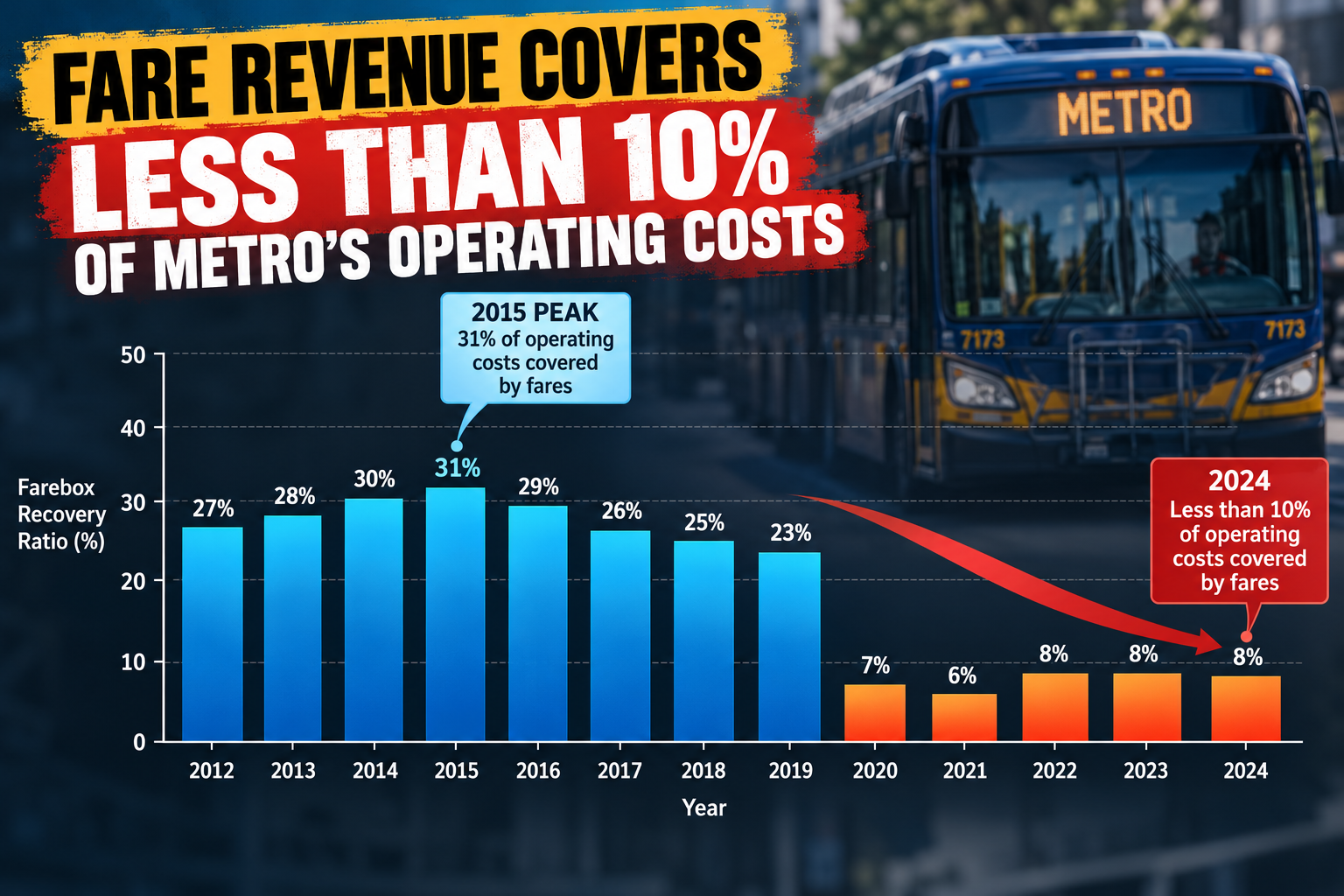


In recent years “equity”, though not always clearly defined, has become a major public policy objective. For example, Sound Transit has adopted a policy calling for “Fairness in process, distribution of resources, opportunity and provision of varying levels of support upon need to achieve greater fairness of outcomes.” I think I understand what they are trying to say, and it is a commendable policy goal.
It has been commonly assumed that public transportation service improves equity by increasing mobility and access to jobs for lower income individuals. However, a close look at how transit in the Puget Sound region is funded and who it serves leads to a very different conclusion.
Within King County there are about 874,000 households living in the Sound Transit taxing district. In 2024 the average household paid about $1,700 per year in taxes to Sound Transit, and approximately another $670 per year to King County Metro, for a total of about $2,370 per household per year. Most of that comes from sales tax with the rest from motor vehicle excise tax and property tax. That total does not include additional property tax and fee revenue collected by the state and city of Seattle that also subsidizes transit.
The sales tax is notoriously regressive, meaning it falls disproportionately on lower income households. The property tax is also somewhat regressive because lower income households tend to spend a higher percentage of their income on housing. Similarly, the motor vehicle excise tax can be regressive for lower income households that require an automobile for work or for childcare needs. This demonstrates that the funding mechanism for transit works against the equity goal. Lower income households are paying a very high price for transit service.
Mobility benefits are the other side of the equity equation. Though it is widely assumed that lower income workers rely on transit, Census data shows that’s not the case (see graph below). More than 81% of Puget Sound residents with incomes below $50,000 per year commute by car (68.3% as single occupant drivers, 13.6% carpool). Only 9.4% commute on public transit. This means the vast majority of lower income residents benefit very little, or none at all, in return for the thousands of dollars per year they pay in transit taxes.
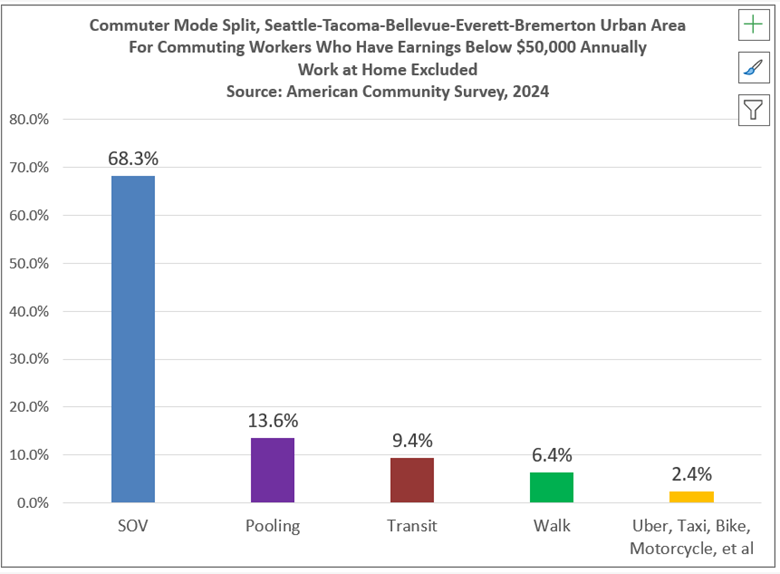
Rather than correcting an inequity, the combination of regressive taxes and the small percentage of lower-income transit commuters is producing less equitable outcomes, as well as making the region less affordable for struggling low-wage workers.
Transit agencies have attempted to address this problem (without really admitting it is a problem) by subsidizing monthly transit passes for low income households through the ORCA LIFT program. But as of 2024 only 12,567 people were enrolled, which is only a tiny fraction of one percent of all lower income households in the County. An ORCA LIFT transit pass entitles the holder to pay a fare of just one dollar on most transit service in the region. That is a bargain, but it doesn’t benefit the 81% of low income commuters who drive or carpool to get to work, and it doesn’t correct the problem of the high regressive taxes used to fund transit.
The plans of transit agencies, cities and regional planning organizations all emphasize the role of transit in serving the economically disadvantaged population. To address mobility needs the Puget Sound region now spends in excess of $3 billion per year on transit, which is one of the highest per-capita transit subsidies in the United States.
So why do only a small percentage of low income workers commute by transit? A comparison of travel times shows that for a thirty-minute commute nearly half the jobs in the Puget Sound region are accessible by car, but less than two percent can be reached by transit within that time. If we expand the commute travel time to forty minutes the percentage of jobs accessible by car increases to over 70%, but the percentage for transit increases only slightly to just under 4%. In other words, the mobility advantage of the automobile is so great it should come as no surprise it is the preferred mode regardless of income. Income levels vary greatly across the socio-economic spectrum, but everybody is allocated the same twenty-four hours per day, no more, no less, regardless of income or anything else. If a policy goal of transportation is to provide equitable access, especially for lower income citizens, then heavily subsidizing a mode that isn’t time-competitive for connecting people with jobs isn’t an effective way to address the problem.

Obviously, there is a segment of the population that doesn’t have access to an automobile and there is a case to be made for providing public transportation for those individuals. The challenge for planners and policy makers is to devise a system that accomplishes that at reasonable cost. The Puget Sound region’s very high-cost transit plans combined with the regressive taxes that fund those plans have become the source of inequity rather than the solution.
Sound Transit's "enterprise initiative" to bring the cost of the ST3 plan within the $150 billion budget is an opportunity to correct some of the current inequity, but so far that effort has focused on building high-cost and low ridership light rail extensions that will worsen equity outcomes.