

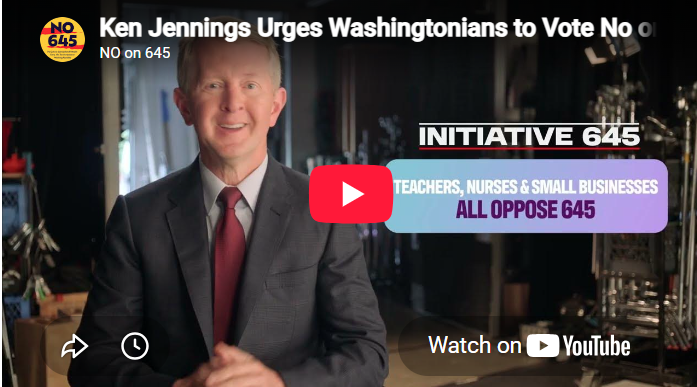
Ken Jennings was in a recent TV ad offering Washingtonians a "pop quiz" on Initiative 645, but while he might be the undisputed king of trivia, his 30-second spot proves state tax policy is definitely not his strongest category.
While giving the wrong response on Jeopardy! only costs you virtual dollars, repeating the “No on 645” campaign’s false claims will cost voters actual money.
Whether Washington should have a state income tax is ultimately a decision for voters, but regardless of how anyone plans to vote, these claims deserve an immediate reality check.
1. Opponents claim I-645 raises taxes on working families and small businesses
Opponents argue that I-645 takes away the funding source (the income tax) while leaving all the "goodies" (the accompanying tax relief provisions) on the books at a time when the state claims to have no money. To make matters sound worse, critics assert that lawmakers are constitutionally prohibited from altering those remaining tax-relief provisions for two years.
Both assertions are false.
While the legislature should be doing everything in its power to provide genuine tax relief after overseeing massive tax increases per capita, lawmakers who claim their hands are tied financially are being disingenuous. If they truly felt constrained, they could simply repeal or adjust the tax relief provisions in 2027 or 2028, well before they are scheduled to take effect in 2029.
Second, the legal premise that lawmakers cannot touch these provisions for two years misinterprets state law. The constitutional two-thirds vote requirement to amend an initiative would not apply to the tax relief or expansion of the Working Families Tax Credit. I-645 repeals the income tax; it does not reenact or amend the underlying tax relief statutes. As a 1988 Attorney General opinion explicitly clarified, lawmakers remain free to legislate on related subjects without a supermajority as long as they preserve the initiative’s core purpose.
2. Opponents claim public pensioners will not have to pay
Labor union leaders and opposition campaigns repeatedly assure voters that public pensioners will not have to pay the income tax because no public pension reaches the $1 million threshold. But if public pensioners will never have to pay, why did lawmakers spend 14 detailed sections of the income tax bill ensuring that public pension income explicitly applies?
Look no further than page 43 of the bill: Section 810 strips away long-standing PERS tax protections to subject those retirement benefits to the new income tax, while Section 806 does the exact same for teachers’ pensions.
When pressed, labor leaders like April Sims claimed this was done to "close a loophole." What loophole? No one knows. Having been flown around the country as an expert to work specifically on state pension issues, I can tell you unequivocally that there is no federal rule requiring state public pensions to be taxed, and a number of states fully exempt public pensions from their income taxes. There was no "loophole" to close.
So, what reason would there be to go through all those sections stripping protections from public pensions?
The answer is one of two things: either someone gave the bill writers terrible advice that they needed to include public pensions (which is highly unlikely), or lawmakers wanted to get the fight over pensions out of the way now before public pensioners begin paying and noticing once the threshold is lowered. By getting public pensions into the tax structure up front, lawmakers ensure retirees automatically start paying the moment the deduction is reduced.
3. Opponents claim voters must approve any expansion or lowering of the threshold below $1 million
The opposition’s voters’ pamphlet rebuttal promises: "Any attempt to expand it to those of us making under a million would be decided on the ballot."
There is no automatic public vote. The $1 million standard deduction exists in ordinary state law, which the legislature can lower or eliminate at any time through a simple majority vote. In fact, during debate on the income tax bill, Rep. Chris Dufault offered an explicit amendment requiring a public referendum before the deduction could ever be reduced. The House majority rejected it. The voter protection being promised in campaign literature was offered and deliberately defeated.
Furthermore, when the legislature eventually moves to lower the threshold, they will almost certainly attach the exact same anti-referendum emergency clause they placed on the original income tax bill, declaring that "The tax imposed in this act is necessary for the support of the state government and its existing public institutions."
Attaching that language legally blocks citizens from filing a referendum to stop the lowered threshold from taking effect. To fight back, voters would be forced to launch a statewide citizen initiative, requiring supporters to collect over 300,000 signatures and spend millions of private dollars to advocate against lowering the threshold, while facing tens of millions of public-sector union dollars opposing them.
Opponents will claim that failing to lower the threshold requires cutting education and health care funding. This will then trigger a Public Impact Disclosure Statement (PIID), allowing the Attorney General to put his thumb on the scale of the ballot outcome. The fact that the PIID statute has not been found unconstitutional is ridiculous, but it represents the exact tilted playing field taxpayers will face.
4. Opponents claim I-645 cuts $13 billion from schools, hospitals, and childcare
Claiming that I-645 "blows a $13 billion hole in the budget" fundamentally misrepresents how state budgeting works. The income tax has not collected a single dollar, and its first payments are not even due until April 2029. Consequently, not a single school, hospital, or childcare program receives a penny of income tax funding today and won’t until the 2027-29 budget is adopted next year. You cannot cut money out of a budget when that money was never in the budget to begin with.
Equating a reduction in future projected revenue with actual spending cuts is a deliberate scare tactic. General fund revenue projections naturally fluctuate based on economic conditions. Under the opposition’s flawed logic, whenever projected state revenue dips for any reason, the state is "cutting education." By that standard, passing a sales-tax exemption, offering small-business credit, or experiencing a mild economic slowdown would all be labeled "cuts" to public schools.
The state's $80.2 billion operating budget is already fully funded with existing revenues. Repealing an uncollected income tax forces lawmakers to adjust their future spending plans, but it does not order a single dime to be cut from current school or hospital operations.
Conclusion
Initiative 645 gives voters a clear choice: repeal a brand-new income tax before the first payments are due in 2029, or trust that lawmakers won't lower the threshold after they've already cleared the legal path to tax public pensions. Understanding the facts makes that choice obvious.