

The IRS released its latest state-to-state migration data last week, and for the second year in a row Washington ranks among the worst states in the country at holding on to its highest earners.
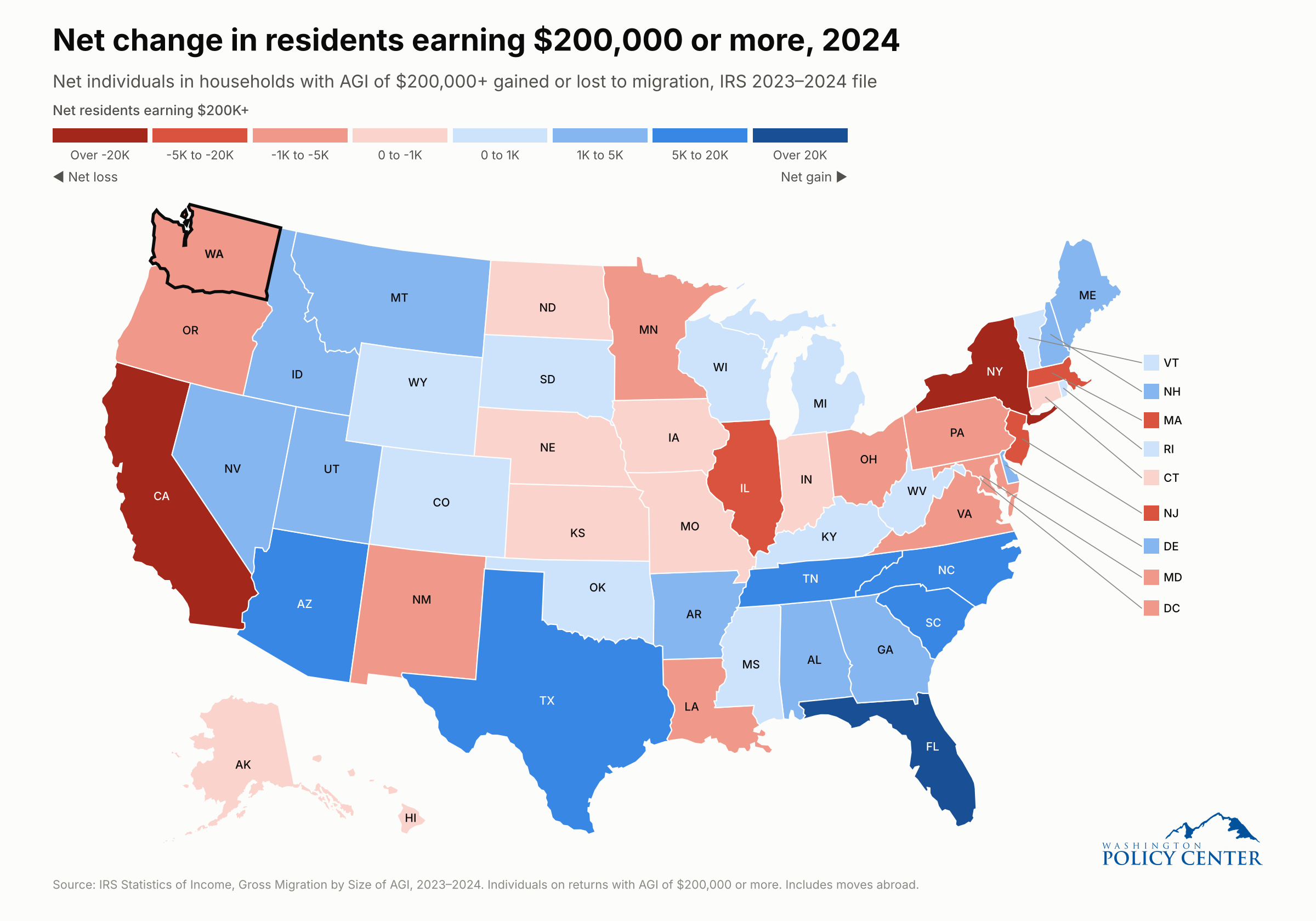
Comparing the addresses on tax returns filed in 2023 and 2024, the IRS found that Washington lost a net 4,527 residents from households earning $200,000 or more, a loss exceeded only by California, New York, Illinois, Massachusetts and New Jersey.
Washington lost a net 5,875 high-earning residents in the prior year's data as well, when it also ranked sixth-worst in the country, which brings the two-year loss to 10,402 people from the state's highest-earning households.
For context, the state expects around 25,000 households to pay the income tax in 2029.
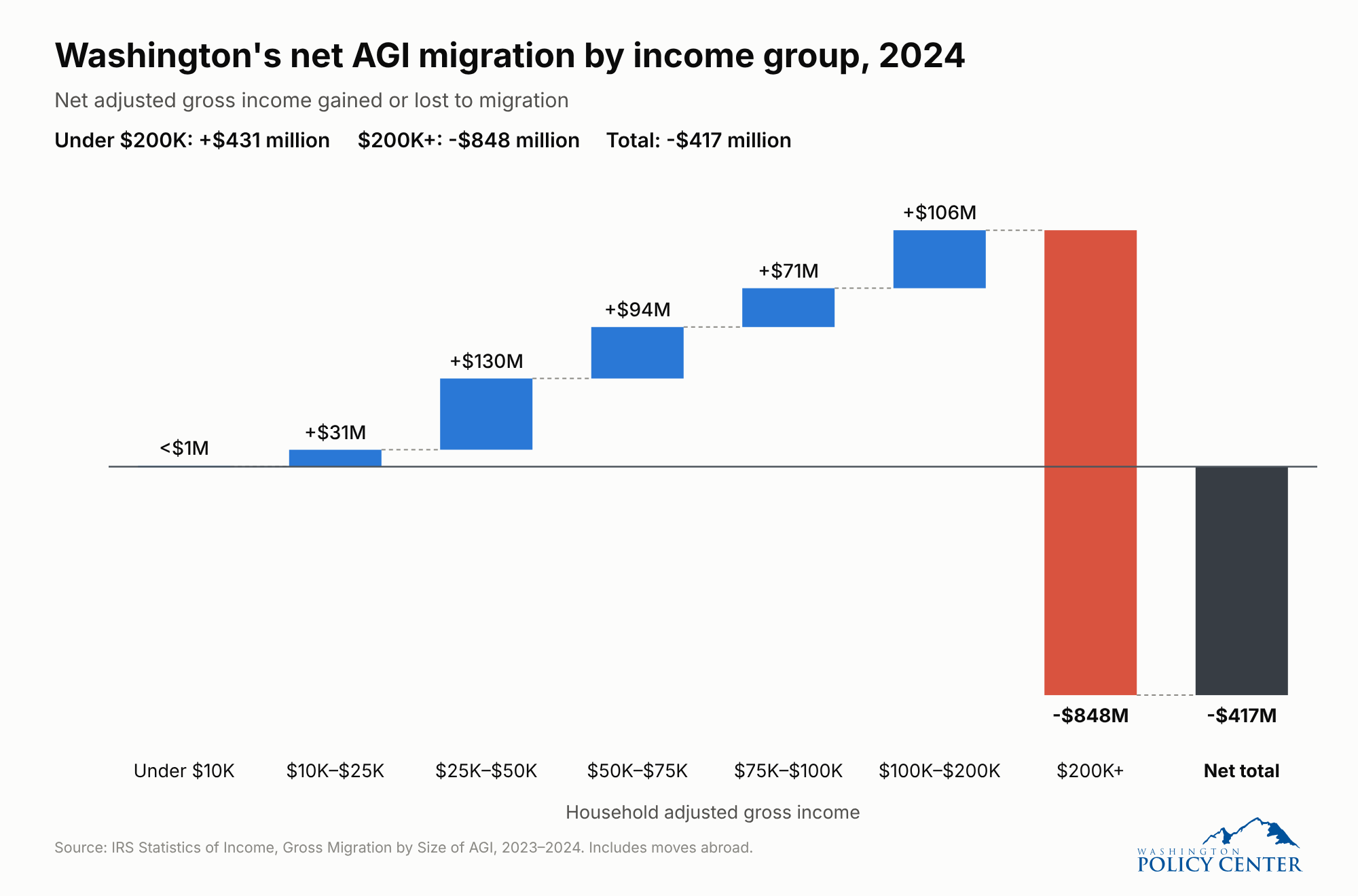
On net, departing high earners took $1.19 billion in adjusted gross income (AGI) out of the state in the 2023 data and another $848 million in 2024, a little more than $2 billion over the two years.
Every income group below $200,000 moved in the opposite direction in 2024, adding a combined $431 million to state AGI. People are still choosing to move to Washington, but the households leaving have the highest incomes, and they took enough with them to erase those gains and leave the state down $417 million in net AGI, counting moves abroad. The 2023 data showed the same pattern, with a net loss of $558 million.
Across all households, Washington's largest net income losses in 2024 went to Arizona ($399 million), Idaho ($222 million), Florida ($169 million), New York ($131 million) and Nevada ($114 million).
The National Taxpayers Union Foundation (NTUF) estimates how much tax revenue migration costs a state by applying the Tax Foundation's measure of its effective state and local tax burden, which for Washington is 10.7%. On the 2024 high-earner losses alone, that works out to about $91 million a year in state and local taxes, and on the full $2 billion in high-earner income lost over both years, about $218 million a year.
Even that figure likely understates the hit to the state budget, because Olympia's newly passed taxes lean on exactly these households. The capital gains tax, the estate tax, and the 9.9% tax on income above $1 million, signed in March 2026 and taking effect in 2028, all fall on a narrow group of high earners, and the moves in this data came right after the state Supreme Court upheld the capital gains tax in 2023 and the first payments came due.
Lawmakers are building an increasingly expensive government on an increasingly narrow tax base.