When launching the U.S. Conference of Mayors' Climate Protection Agreement, former Seattle mayor Greg Nickels promised the city would set an example for the nation by meeting the carbon emissions reductions in the Kyoto Protocol. Nickels said the city's emissions would be 7 percent below the 1990 levels by 2012.
On his way out of office in December of 2009, he triumphantly declared victory.
Reporting on a study released by the mayor's office in December of 2009, The Seattle Times wrote, "The city of Seattle last year produced 7 percent less greenhouse gas than it did in 1990 — a target the city had hoped to meet by 2012." Some in the environmental community were quick to praise the mayor and the achievement. Alan Durning, of the left-wing environmental think tank Sightline Institute, told the Times, "I'd say the city of Seattle did better than I expected."
At the time, WPC noted that the city's accounting was misleading, relying more on accounting tricks that put most emissions off of the balance sheet than on an honest assessment. We also made this argument in 2007 when the initial version of the Seattle carbon emissions report was released.
Now, a presentation to the Seattle City Council last week admits the city's previous reports were false, relying on exactly the tricks we highlighted.
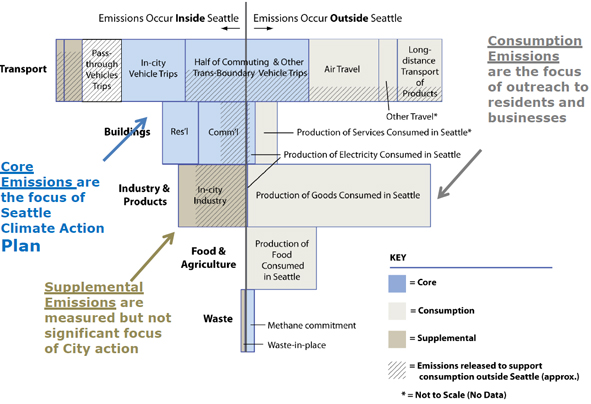
As demonstrated in the chart below taken from the presentation to the council, most of Seattle's CO2 emissions occur outside the city limits. The carbon emissions reports released by the city in 2007 and 2009, however, counted only the emissions inside city limits.
Notice also that "In-City Industry" is not a significant area of focus of city policy. The two previous carbon emissions reports, however, specifically take credit for reductions those emissions. In 2009, the city bragged, "Climate pollution generated by the industrial sector declined by 30 percent from 1990 levels. Cement production, comprising more than 60 percent of all industrial emissions, was down 26 percent since 1990 due to a combination of more energy-efficient production and the economic downturn." Now, the Seattle City Council admits these emissions won't be a significant focus, primarily because city policy can't do much about them.
What's more, note that "production of goods consumed in Seattle" is largely outside the purview of the City Council's efforts. As a result, reducing in-city industry emissions by outsourcing production to other cities actually reduces emissions the city is concerned with, even though such an approach probably increases total worldwide emissions.
Finally, notice that most of the CO2 emissions aren't counted in the City Council's effort to become "carbon neutral." In other words, the council is pledging to become carbon neutral, but only for the emissions they choose to count.
Seattle's carbon reduction efforts have been more politics than science from the beginning. The latest report confirms that Seattle's past Kyoto claims used accounting tricks to make the numbers look good politically, even if they weren't good environmentally.