


How the Department of Ecology and the media missed an obvious error
The “Climate Commitment Act Investments” is a report published by the Department of Ecology that ostensibly detailed the spending of $1.5 billion of CO2 tax revenue from the first two years of the Climate Commitment Act (CCA). It was intended to show the many good things that are being done with CCA revenue to fight climate change, increase resilience and help “overburdened communities.”
Analysis of the report reveals the impact claimed by state officials is seriously overstated and staff that compiled the report at the Department of Commerce, along with the Department of Ecology, admit it, undermining one of the central justifications for the state’s CO2 tax.
The Department of Ecology’s press release announcing the report claimed “CCA investments made during the 2023-25 biennium are expected to directly reduce greenhouse gas emissions by a total of nearly 9 million metric tons,” an amount Ecology touted as the “equivalent of taking 40% of all gas and diesel vehicles in Washington off the road for a whole year.” According to the release, this was accomplished for a price of “$40 per metric ton.”
Both claims are false.
Ecology director Casey Sixkiller praised the report for providing “detailed, transparent information about CCA spending” which “ensures that lawmakers can continue to guide those investments wisely.” But a report giving significantly inaccurate data does not validate that lawmakers have wisely spent taxpayer dollars nor does it provide them guidance for doing so in the future.
And Conrad Swanson, who writes for The Seattle Times’ Climate Lab, a project funded by some of Seattle’s largest environmentalist organizations, touted the release of the report as the “most comprehensive report yet on where CCA money has been spent, all neatly packaged in a publicly available dashboard.” In his story on it, Swanson claimed “questions swirling around the state’s finances now have more answers than ever before” and advised, “the details can all be found on the state’s new dashboard” where his readers should “[t]ake a look around and see what you can find.”
The problem is the report and its press release were taken at face value without the most basic skepticism. A quick analysis shows the report is badly inaccurate. And staff at the Department of Commerce, who helped compile the report, admit it.
About 86 percent of the total CO2 reductions claimed by the report are probably fake.
The error should have been obvious to Ecology staff and to Swanson. It was immediately obvious to me.
The afternoon that the report was released (and one hour before Swanson posted his story), I tweeted that the very low reported cost to reduce CO2 in the report indicated that it was “unreliable.” In fact, the problem I identified that day accounts for the vast majority of the claimed CO2 reductions.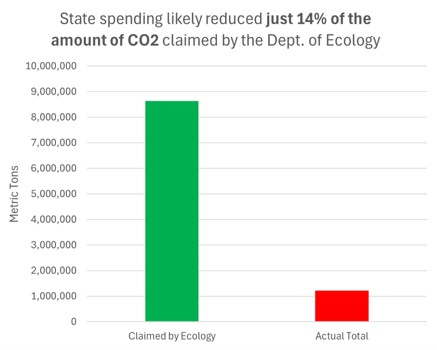
Ecology’s claim that the average cost to reduce one metric ton (MT) of CO2 is only $40 is an obvious indication that the data in the report are wrong. Forty dollars per metric ton is pretty low, particularly when the average cost during the first year of climate projects was $1,410.14 per MT CO2. A drop to $40 would be remarkable if it were true. But it isn’t.
The very low price is skewed by eight projects. The report indicates those projects were able to reduce emissions for just $1 or $4 per MT. This is obviously incorrect. There are probably no projects in the world that can reduce CO2 emissions for that price.
According to the Department of Ecology’s report, those eight projects – out of nearly 3,600 – account for a whopping 86 percent of the total CO2 emissions reductions claimed for all projects. Using Ecology’s own calculation, those projects purportedly reduce the CO2 equivalent of taking about one-third of all gas and diesel vehicles in the state off the road for a year. So, what are these projects?

These projects are part of a grant that provides subsidies to install “high-efficiency electric equipment and appliances.” I’ve included a picture showing five of the eight projects as they are listed in the report.
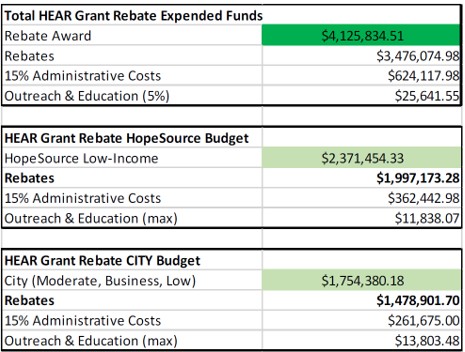 For example, the City of Ellensburg received a grant for $4,125,835 which was used to fund the purchase of heat pumps for low-income families and switch fuel sources. According to a report from the city, twenty percent of those funds were used by the city to cover administrative costs and “outreach and education.” The remaining $3.5 million funded 170 projects that Ecology’s report claims reduced emissions by 3.5 million metric tons. To put that in context, that is equivalent to 60 percent of all energy-related residential CO2 emissions in Washington state for all of 2023.
The notion that heat pumps and other upgrades at just 170 buildings could reduce the equivalent of 60 percent of the CO2 emissions from homes is clearly incorrect. The fact that the staff at Ecology failed to identify such an obvious error indicates how sloppy the report is.
I asked staff from Ellensburg Public Works where the CO2 estimate came from. They explained that the estimate was generated by the state and that they would be tracking energy consumption for each recipient to estimate savings over time.
I requested that they ask the Department of Commerce if they could provide the calculation used to generate the CO2 estimate and Ellensburg staff agreed.
In response, staff at the Department of Commerce responded that, “There was an error in the reported data. Ecology is aware of the issue.” I followed up with the Department of Ecology but received no reply after three weeks.
Notably, there are 43 other grants for similar projects. Those projects report much smaller reductions in CO2 emissions at a cost of $613 per metric ton. It seems likely that there was a data error for the eight projects highlighted above and that the actual cost is the same as the other 43 in the report. If we assume that instead of $1 per MT, the actual cost is the $613 per MT as the other projects, we can generate a more accurate estimate of total emissions reductions.
That one change radically reduces the amount of CO2 reduced by the projects.
If the eight grants in question yield the same average results as the other 43, the total emissions reductions from state spending would be about 1.2 million metric tons of CO2, just 14 percent of what the report claims. That is an incredible error.
To be sure, those eight projects aren’t the only ones in the report that are suspect.
There are five projects related to electrifying ferry docks to accommodate the new hybrid ferries that report very low costs to reduce CO2 emissions – between $5.86 and $16.78 per MT CO2. Oddly, those amounts do not include the cost to build the ferries themselves, which are much more expensive. Without ferries to charge, electrifying the docks yields zero emissions reductions, so it is unclear why it can be claimed that these projects reduce any emissions. It would be more appropriate to include the costs of the entire system and then come up with an estimate.
Those five projects account for another 314,878 MT of CO2, or about one-quarter of the remaining emissions reductions claimed by the report.
Put simply, many of the projects that report the highest emissions reductions are dubious.
If the report is intended to ensure that lawmakers can “guide those investments wisely,” as Ecology Director Sixkiller claimed, once adjusted for accuracy, the report reveals that the vast majority of projects receiving tax dollars are wasteful and ineffective.
After correcting for the eight projects with errors, the average cost of state projects to reduce CO2 is $395.42 per MT. By way of comparison, the state’s CO2 tax is less than one-fifth that amount, at $70.86 per MT. The state’s social cost of carbon, which purports to be an estimate of how much damage each metric ton of CO2 does to people and the planet, is $99 (I have to mention that this number is exaggerated and inaccurate, but that’s for another day). In other words, we are spending $395.42 to avoid $99 of harm. That is simply irresponsible.
When I point these things out, the response is that that spending also provides other, non-climate benefits. The value of those benefits is almost never quantified but simply asserted to justify continued spending on programs that fail by their own metrics. For that claim to be true, however, would require that the non-climate benefits be at least three times as large as the benefit of reducing climate change. If other things are three times as harmful as the “existential crisis” of climate change, then maybe we should focus on those things instead.
What’s more, the spending I’m addressing only includes projects that the state says will yield “quantifiable emissions reductions.” About 70 percent of CCA project spending isn’t even expected to reduce CO2. For example, the nearly $16 million for “bicycle education to elementary and middle school students” we highlighted recently is not expected to reduce CO2 emissions.
In the end, the most troubling aspect of the CCA report isn’t just that it contains serious errors, it’s that those errors overwhelmingly inflate the program’s apparent success. When a handful of dubious projects account for the vast majority of claimed emissions reductions, basic credibility collapses.
If climate policy is going to demand billions of dollars from taxpayers and impose real costs on households and businesses, it must at least be honest about what it delivers. Inflated numbers, uncorrected mistakes, and a willingness to substitute vague “co-benefits” for measurable results don’t advance environmental stewardship; they undermine it. Lawmakers should pause, demand corrected data, and re-evaluate CCA spending against clear, verifiable outcomes, because effective climate policy begins with telling the truth about the math.
[REMINDER: Lawmakers and the governor are calling for an income tax for Washington. Tell them Washington state has seen enough tax increases! Send your message to your local legislators and the governor using out new "TAKE ACTION" tool! ]