
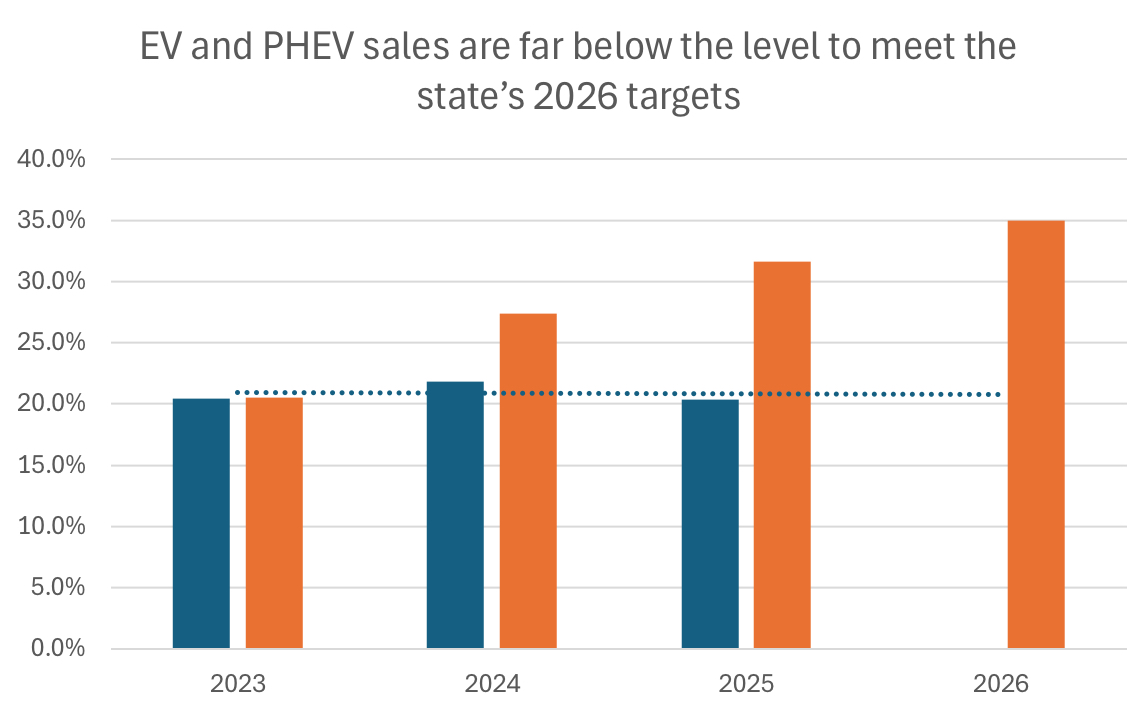

Electric vehicle (EV) sales took a hit in 2025 with the percentage of new car registrations that are all-electric falling to about 17 percent – a percentage point lower than 2024. That decline was punctuated by poor sales in December, when fewer than 10 percent of newly registered passenger vehicles were EVs.
One significant cause of the decline is the loss of the federal EV credit at the end of September. The percentage of newly registered passenger EVs peaked in October at 25.2 percent (new vehicle registrations often lag by a month) and then collapsed to 16.3 percent in November and to 9.4 percent in December.
The reduction in annual sales may not be entirely due to the loss of the subsidy. Government subsidies often simply shift demand forward rather than creating new demand. Cars that would have been purchased in December are moved forward to September to take advantage of the free money. There is some indication that is what happened.
During the months from January to October 2025, 21.2 percent of new vehicle registrations in Washington state — while the federal subsidy was still in place — were either battery electric or plug-in hybrid, both of which are considered EVs by the state. That is lower than the same period of 2024, when 21.8 percent of new vehicle registrations were EVs. Sales of EVs seem to have hit a plateau or slight decline before the federal subsidy went away.
New registrations fell even more during November and December, so the loss of the subsidy probably contributed to the year-over-year reduction in sales, but it would be wrong to say that the decline was entirely due to the loss of the subsidy.
The reaction to the numbers from some will be to throw more money at subsidizing electric vehicles. That doesn’t make sense from an environmental standpoint. The state’s previous program to subsidize EV sales in 2024 yielded a reduction in statewide transportation-related CO2 emissions by a minuscule 0.03 percent for $45 million.
Despite past failures, there is a belief among some in the legislature that EVs must be part the effort to reduce CO2 emissions now, even if much of the public isn’t ready to adopt them. As we have explained many times in the past, spending money on speculative projects that we hope will reduce CO2 emissions in the future is a strategy that is based on hope and ideology, not economics and reality. That approach has been a consistent failure for Washington state and if the lesson from these poor data is that the answer is to throw more good money after bad, Washington will continue to see its climate policy fail.