



For decades, the Seattle region was one of America's premier residential real estate markets. Strong job growth, rising incomes, and an influx of new residents fueled home value appreciation that outpaced much of the country. Today, however, new investment forecasts suggest Seattle's residential market is losing ground compared to other major metropolitan areas.
According to NCREIF ODCE performance forecasts presented in a sector CBSA residential return analysis, the Seattle metro area is projected to generate a 4.2% total investment return over the next year, a 2.6% annualized return over three years, and just a 1.5% annualized return over five years. By comparison, Miami is projected to achieve a 6.6% annualized five-year return, Dallas-Fort Worth 5.2%, Chicago 4.0%, and San Diego 3.8%. Even New York City, long considered a mature and highly regulated market, is forecast to outperform Seattle over the next five years at 3.6%.
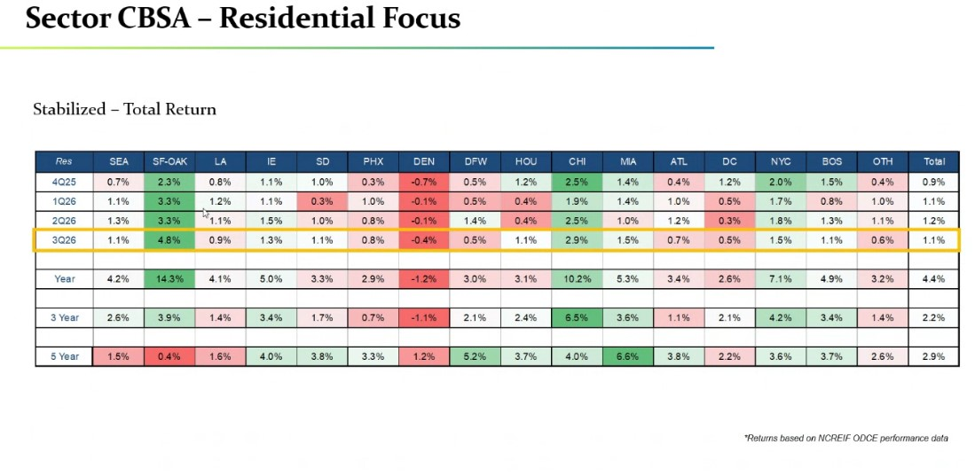 Source: NCREIF ODCE Residential CBSA Forecast Table, "Stabilized - Total Return," showing Seattle projected returns of 4.2% (1-year), 2.6% (3-year annualized), and 1.5% (5-year annualized) compared with Miami (6.6%), Dallas-Fort Worth (5.2%), Chicago (4.0%), and New York City (3.6%).
The most striking aspect of the data is not that Seattle is expected to decline. Rather, Seattle is expected to underperform. In an era when capital can move freely between markets, relative performance matters. Investors seeking residential opportunities will naturally look toward regions offering stronger long-term returns.
Several factors are contributing to Seattle's weakening outlook. Housing affordability remains among the worst in the nation, making it more difficult for first-time buyers to enter the market. Regulatory uncertainty continues to grow as policymakers debate rent control, expanded tenant regulations, income taxes and now a corporate income tax and increased development mandates. At the same time, population growth has slowed compared to many Sun Belt competitors that have embraced housing production and economic expansion.
The result is a troubling combination. Some of the nation's highest housing costs coupled with some of its lowest projected long-term residential returns.
Seattle remains an attractive place to live and work. The region benefits from a highly educated workforce, globally recognized employers, and extraordinary natural amenities. Yet those strengths alone may no longer be enough to sustain superior housing market performance.
If policymakers want Seattle to remain competitive, they should focus on increasing housing supply, reducing regulatory barriers, and restoring confidence that long-term investment in the region will be rewarded. The latest forecasts suggest other metropolitan areas are already doing a better job.