

King County Metro’s tax plan would triple car fees
Pierce and Snohomish County officials plan to add bus service without raising taxes
Introduction
King County and Metro Transit officials want to raise the tax burden they place on citizens to increase spending on buses and roads. The plan comes with a serious threat to the public. Officials want to cut Metro bus service by 17 percent if voters do not approve of new taxes.
One of the tax increases they want to impose is the Motor Vehicle Excise Tax (MVET), a yearly tax on a car’s value. King County officials are seeking increased authority from the state legislature to charge the MVET. If they do not get it, they plan to use existing authority to impose a new, $60 annual registration fee on vehicle owners and a sales tax rate increase of 0.1 percent on consumers, bringing the county sales tax rate close to 10 percent. Both proposals are subject to a public vote.
Voters in Seattle and around the state have passed laws to keep car taxes low. Voters passed both Initiative 695 and Initiative 776 to keep car tab fees at $30. Three years ago, Seattle voters rejected Proposition 1, a $60 car tab increase mostly for transit, with 57 percent of the vote. Now officials are again pushing for new taxes, mostly to devote more money to transit, with most of the financial burden falling on drivers.
Motor Vehicle Excise Tax
King County leaders want to impose the unpopular MVET on car and truck owners living in the county. The county MVET would be a yearly tax based on the estimated value of each vehicle. Many people would pay the tax multiple times in one year, because officials want to apply the tax to a wide range of vehicles, including cars, trucks, motorcycles, motor homes, and personal use trailers. Some working families could pay the tax on as many as five or six different vehicles and trailers each year, resulting in hundreds of dollars in new taxes per family.
A majority of King County residents already pay a yearly car-value tax to Sound Transit, the rail and bus agency in the Puget Sound region. Sound Transit officials currently impose a 0.3 percent MVET on a vehicle’s value. King County Metro officials want to impose an additional 1.5 percent MVET to add money to their own bus agency and for county roads.
If approved by voters, drivers living in Sound Transit’s taxing district and in King County would pay separate MVET taxes on cars, trucks and trailers to both agencies. For example, the owner of a $10,000 car would pay $150 to King County and $30 to Sound Transit, for a total of $180 in car-value taxes on one vehicle, not counting the inflated price schedule that officials use to set a vehicle’s value, which is described below.
Motor Vehicle Excise Tax (MVET) seen as unfair
In addition to the high tax burden imposed on families, many people see the MVET as unfair because of the controversial method officials use to set a vehicle’s value. Currently, Sound Transit officials use an inflated depreciation schedule instead of fair market value to determine the tax burden they impose on vehicle owners. This results in the overvaluing of most vehicles for tax purposes.
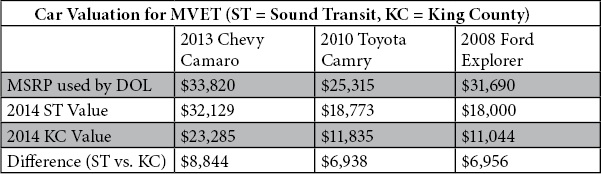
For example, the fair market value of a 2010 Toyota Camry driven 12,000 miles per year is approximately $12,300. However, Sound Transit officials value the car at $18,773 for tax purposes, nearly $6,500 higher. Therefore, the owner of this car will pay $56 in Sound Transit car taxes in 2014. If the taxes were based on the car’s true and fair value, that tax would be only $37.
King County Metro officials plan to use a similar skewed, though less exaggerated, pricing schedule. They would value the same 2010 Toyota Camry at $11,835 for tax purposes, nearly $7,000 lower than Sound Transit’s valuation. The vehicle would be inconsistently valued by different government agencies for MVET purposes, and the owner would have to pay both taxes (see Appendix A for details).
Funding would be diverted away from public roads
How the new tax revenues would be spent also raises questions of fairness. Drivers currently pay most of the taxes and fees that fund the building, maintenance, and operation of transportation infrastructure. If local officials impose the new MVET, 40 percent of the new money collected would go to roads, bicycle improvements and pedestrian projects. Sixty percent of MVET revenues would be diverted to transit.
Diverting money to transit and other modes siphons tax money paid by drivers away from the public road network they use. King County officials say one reason they want a tax increase is because county roads are aged and deteriorating, yet they admit the new taxes they propose would do little to solve the problem.
Financial impact on working families
Many families that own a single car are low-income or middle class without much disposable income and the flexibility to use transit. They depend on a public road network that is congestion-free and in good working order to get to their jobs, make it home for dinner, or pick up their children from daycare. King County officials’ proposal would triple some families’ car tab fees, but do little to make trips quicker or improve road safety.
A one-car family with a $10,000 car will pay about $73 next year to renew their tabs, depending on where the family lives. If King County officials succeed in raising taxes, the burden County officials impose on this working family would triple to $223 in 2015 and every year afterwards.
Other examples of the sharp rise in the tax burden County officials want to impose are shown below:
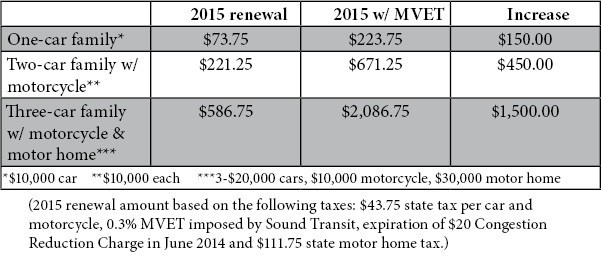
Families that have more than one vehicle would see a sharp rise in their yearly license tab renewal cost. A two-car family with a motorcycle would see a $450 jump in renewal fees. A three-car family with recreational vehicles would pay over $2,000 per year to renew car tabs.
Proposed $60 yearly fee on all car registrations
If King County officials do not get increased MVET taxing authority from state lawmakers, they plan to impose a $60 yearly fee on all car registrations in the county. Unlike the MVET, the $60 yearly fee would apply to vehicles regardless of value. The increased tax burden would fall hardest on the unemployed, students, the elderly and low-income families living on fixed incomes.
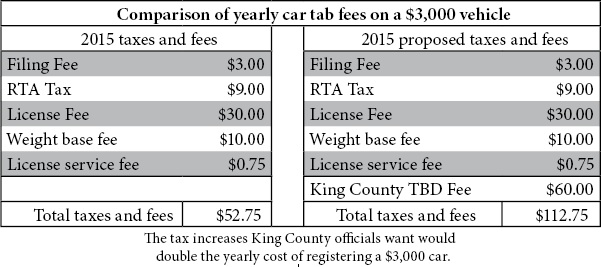
Many college students, low-income families and disabled people own low-value vehicles. If King County officials impose the $60 registration fee, the owner of a $3,000 car would pay over $110 per year to renew their tabs, a disproportionate burden compared to the taxes paid by wealthier people.
Sales tax increase
In addition to the annual $60 registration fee, King County officials want to increase the sales tax paid by county residents by 0.1 percent, raising the total rate to 9.6 percent in most cities. This increase would make the sales taxes charged in many communities the highest in the state. King County officials often point to the volatile and regressive nature of the sales tax and how it falls hardest on poor families, but in this case they are seeking a sales tax increase anyway.
Tax increase may not be needed to save bus service
Yet do Metro officials really need new revenue to avoid the cuts in bus service they are threatening? Officials in neighboring counties are planning to add service this year, without imposing new taxes.
Last year Pierce County officials threatened cuts in bus service. In January, officials threatened to cut 34 percent of bus service if they did not receive more tax money from the public. Five months later, they scaled back the planned cuts to 28 percent. Finally, Pierce County officials now say they plan to add bus service, and they have dropped plans for a tax increase and have stabilized their six-year budget. Similarly, officials in Snohomish County plan to add bus service this year without raising taxes.
Transit is not underfunded
Contrary to the impression transit officials give the public, transit is not underfunded in Washington state. Total operating revenue collected statewide grew from $1.5 billion to nearly $2 billion in 2012, a 30 percent increase.
In contrast, in 2012 the entire state collected $1 billion in gas tax revenue, the primary source of highway funding in the state. The high level of transit funding is remarkable considering that public transit agencies serve less than three percent of all daily person trip demand in Washington.
What ever happened to $30 car tabs?
In 1999, Washington voters passed Initiative 695, to lower the state fee for yearly car tabs to $30. Opponents of the initiative sued and the state supreme court overturned the measure. Seeing the idea’s popularity, state lawmakers of both parties then voted to lower state car tab fees and Governor Locke signed the bill. Lawmakers, however, allowed many existing local taxes and fees to remain.
In 2002, voters passed Initiative 776, to again set car tab fees at $30 per year and to repeal local taxes and fees. This time the state supreme court upheld the initiative, but allowed Sound Transit officials to continue to impose their MVET until the long-term bonds they had issued are paid off.
Since then, state and local officials have increased and added fees, raising yearly car tab renewal costs to well above the $30 standard sought by voters. King County officials now want to add to the higher cost of car tab renewals, moving the public policy farther from the $30 standard.
Conclusion
It does not serve the broader public interest for King County officials to raise taxes on drivers to provide increased taxpayer subsidies for other modes of transportation. Drivers have their own infrastructure needs, and increases in the taxes they pay should be devoted to better roads, highway safety and bridge improvements. King County officials admit that county roads would remain in a neglected state with or without their proposed tax increases. This admission raises serious questions about their management of public funds and the soundness of their long-term financial plans.
King County officials also say tax increases are needed to maintain bus service levels, and threaten cuts if they do not get more tax revenue. They claim a policy change made by voters 14 years ago, passage of Initiative 695, puts them in a financial bind today. Still, King County officials have increased sales taxes twice since then, promising 1.2 million hours of new bus service if voters approved their requests for higher taxes. Voters agreed, but to date King County officials have failed to deliver nearly two-thirds of the promised level of service.
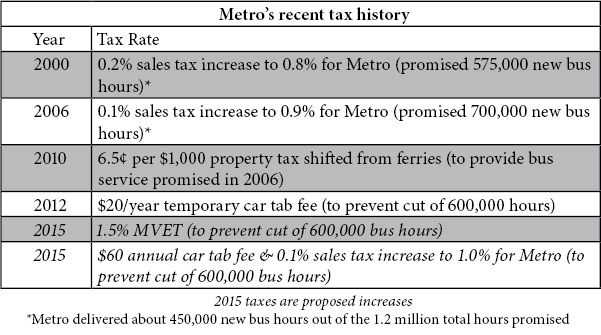
There is no indication that, if King County officials received the taxes increases they are seeking today, they would be any more reliable in following through on the promises they are making now. A large tax increase to pay for current bus service would mean the public would simply pay more to receive the same amount of bus service promised under current revenues.
Transit is not underfunded in Washington state. Officials in Pierce and Snohomish counties are increasing bus service without raising taxes. Metro’s recent sales tax increases and the example of neighboring transit agencies show Metro’s financial problems are not caused by lack of revenue. King County officials appear to lack long-term fiscal planning and a management vision for making bus service sustainable and reliable for the public. Without a change in the management culture at King County and the Metro transit agency, it is unlikely increased tax revenue would solve the county’s roads and public transit problems.
Appendix A
Unfair? How Sound Transit taxes your car
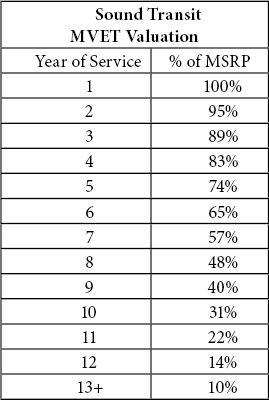 In order to calculate the value of your car, Sound Transit uses the following valuation schedule found in RCW 82.44.041 (repealed by I-776 but Sound Transit can continue to use):
For example, a 2010 Toyota Camry had a retail price of $25,315 per the Washington State Department of Licensing. Since it has been on the road for five years, its taxable value (per Sound Transit) is 74 percent of $25,315, or about $18,667.
How King County would value your car
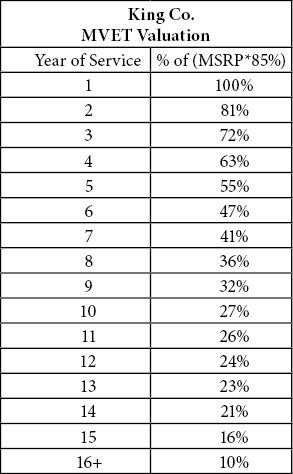 If King County officials impose an MVET, they would use the valuation in RCW 82.44.035. To calculate taxes, the owner of the Camry would calculate 85 percent of the retail price, and then multiply the result by the depreciation percentage. In this case, the value of the car for King County taxes would be $11,835.
Two different values, same car
For clarity, a few examples follow that highlight the difference between valuations depending on who is imposing their MVET:
Download a PDF of this Policy Note here.